Walk the aisles at Zhongda and you will hear "we are the factory" more than once. A real source dyeing factory (knitting-and-dyeing mill) owns or controls knitting and dyeing, and can talk you through yarn lots, dye routes and approved samples; a trader (middleman) mostly resells stock. For nylon spandex (polyamide elastane) weft knits, sample at Guangzhou Zhongda, check composition, GSM, width and stretch recovery, agree dye-lot rules and seal the approval before you discuss custom dyeing and bulk.
What is the difference between a source dyeing factory and a trader?
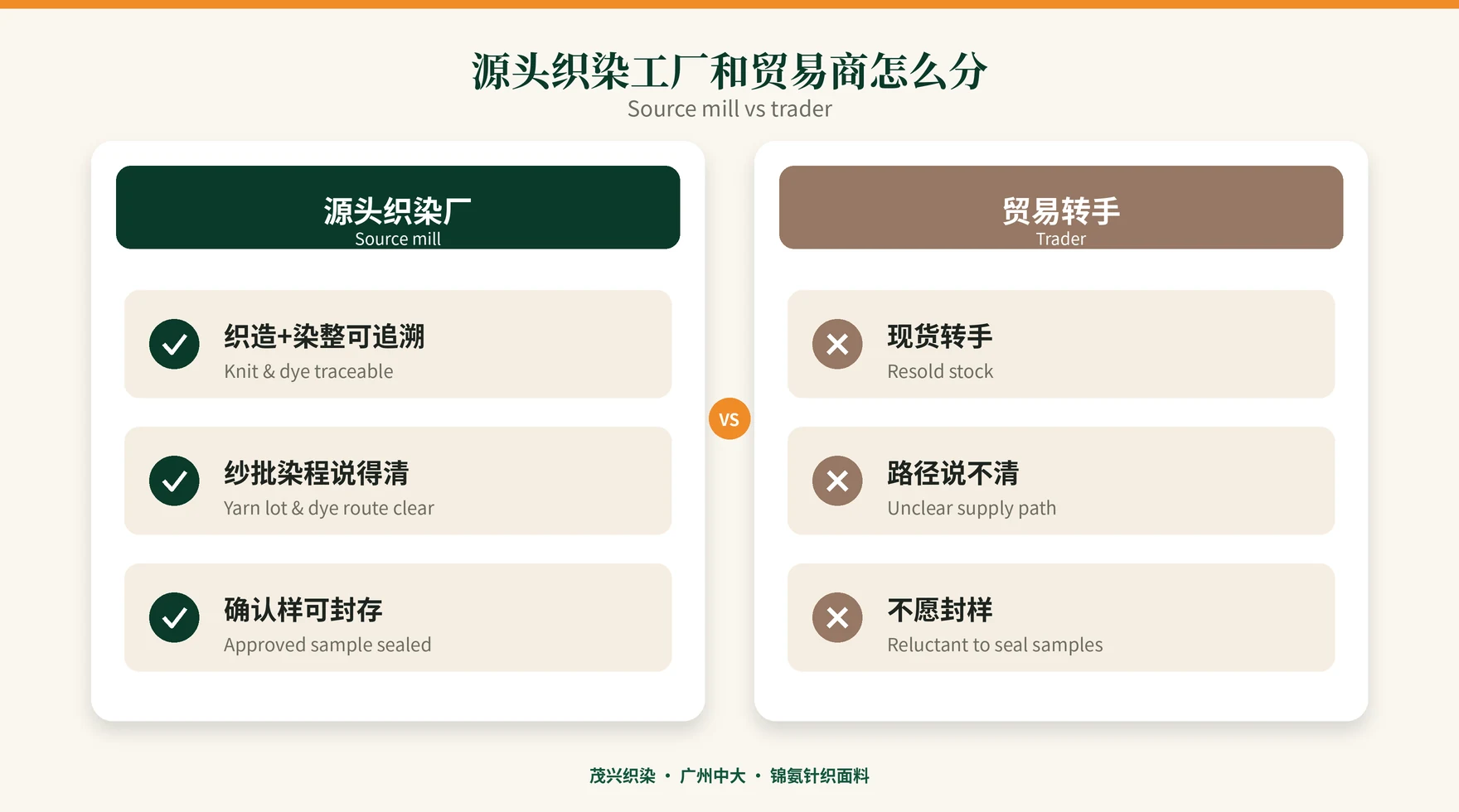
A source dyeing factory controls knitting and dyeing; a trader mainly matches stock and timing. A source dyeing factory (knitting-and-dyeing mill / source mill) can tell you which yarn, which knit construction and which dye route, and it stands behind shade continuity and sealed approvals. A trader (middleman / wholesaler) more often runs stall stock and handles resale follow-up.
For nylon spandex (polyamide elastane / nylon-spandex knit), the real test is whether yarn lot and dye route are frozen against an approved sample, not what the business card says. At Zhongda in Guangzhou, open with one question: do the cutting and the bulk share the same yarn lot and dye route?
How do you verify real knitting and dyeing capability?
Verify the evidence chain, meaning knitting and dyeing you can trace, rather than a self-claimed "source" label. Run three checks:
- Knit type and how yarn lots are controlled.
- How the head lot is matched, and who keeps the approved sample (sealed swatch / confirmation sample).
- Whether spoken claims match the tags for composition, GSM, width and meters-per-kg.
A genuine knitting-and-dyeing mill (source dyeing factory / source mill) can walk you from cutting to approval to bulk. Stock-only answers with no dye route behind them point to a trader (middleman). Lock sample responsibility first; the plant tour can come later.
What parameters should you check when sampling?
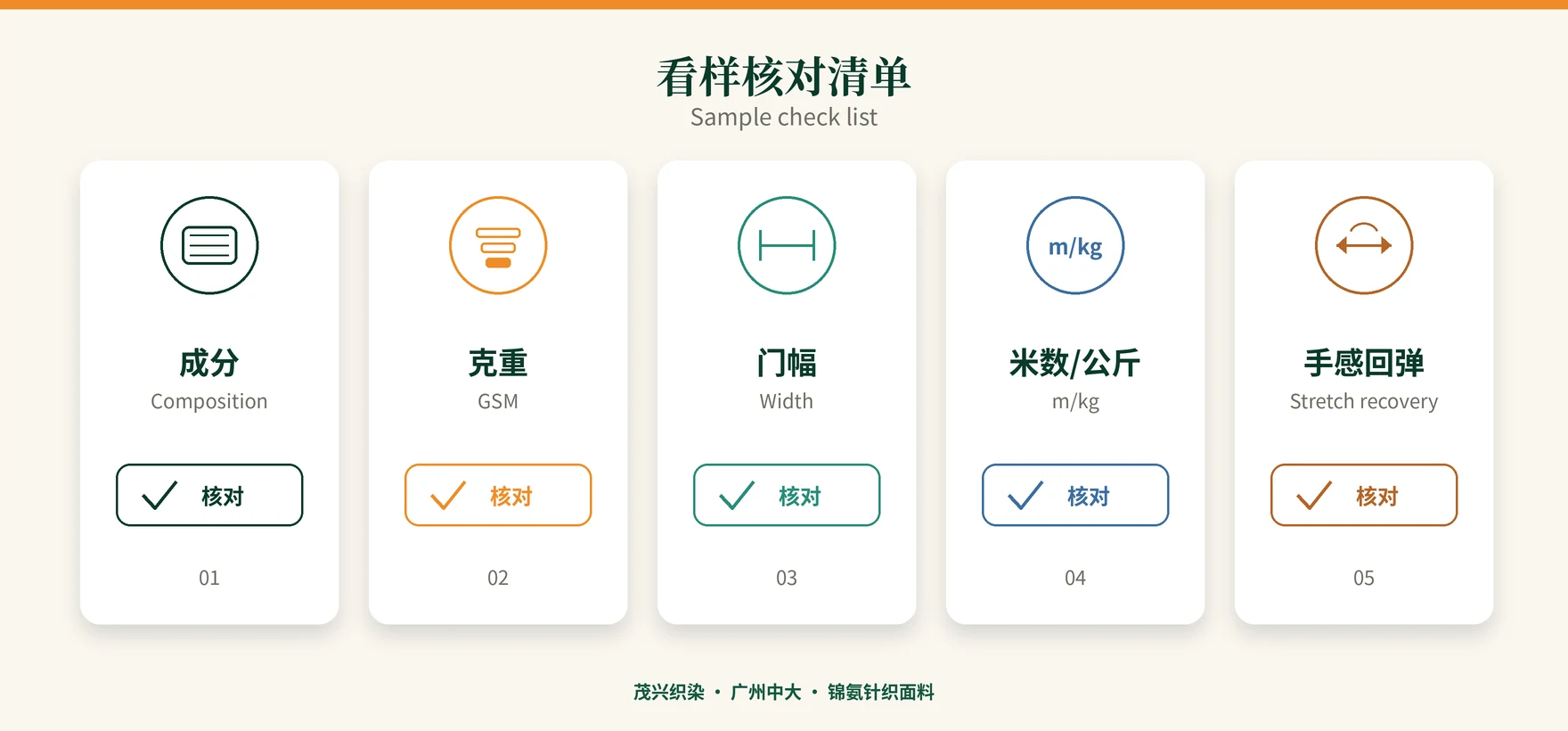
Lock composition, GSM, width, sales unit and stretch recovery first; treat spoken numbers as provisional until the tag and order confirm them. On nylon spandex (polyamide elastane) weft knits, go through fiber ratio, GSM as a cover clue, usable width, kilo versus meter (and m/kg), and hand-pulled stretch recovery in both directions.
At Guangzhou Zhongda, write down style codes and dates as you go. Keep these checks qualitative; they are not lab certificates.
At Maoxing we have worked nylon spandex (polyamide elastane) knits at Zhongda in Guangzhou for 15 years, with our own knitting mill and our own dye house, 300+ weaving machines and about 160 tons of finished fabric a day. Our contact details are at the end of this page.
How should you negotiate custom dyeing and dye-lot difference?
Agree the approved sample and shade tolerance before lead time and split-lot rules. Custom dyeing (lab-dip route / made-to-shade) is for when stock shades fall short; dye-lot difference (shade variation) is a familiar problem on stretch knits. Work through it in this order:
- Seal a swatch and name the light source.
- Align the head lot and later lots on yarn batch and dye route.
- Write accept/reject rules into the order.
- Keep lead time subject to order confirmation and approved samples.
A source dyeing factory (dyeing mill / knitting-and-dyeing mill) can map the dye-route milestones. In our own dye house, custom dyeing typically takes about 10 days, confirmed on the order. If the answer is "we'll ask the dye house later," build in extra buffer.
How do you lock risk from sampling to bulk?
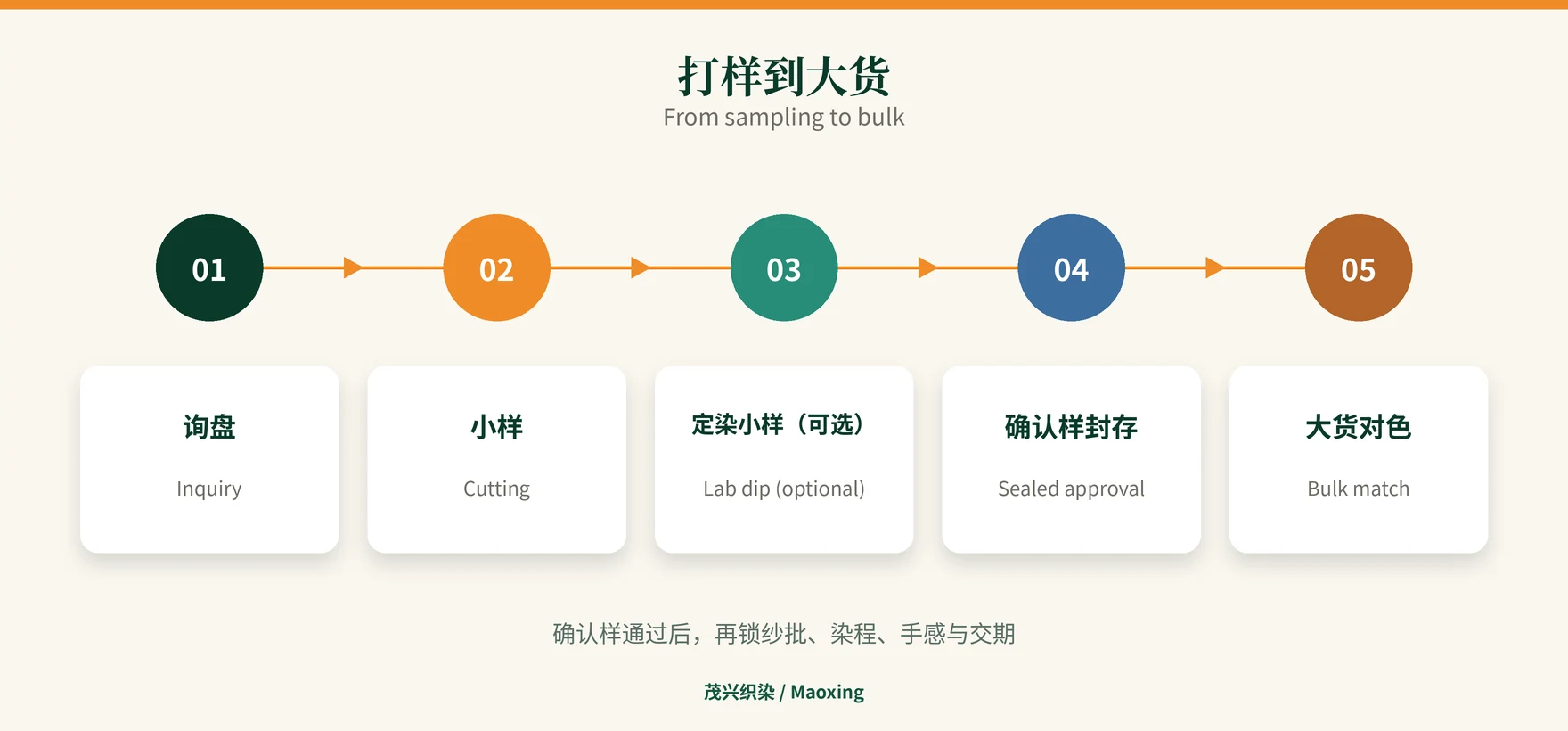
Release bulk only after the approved sample has frozen yarn lot, dye route and hand standard. The path runs: inquiry → stock or color-card cuttings → optional lab dip → sealed approval → bulk shade re-check. Put composition, GSM, width, m/kg, hand feel and timing in writing.
Nylon spandex (polyamide elastane) for yoga, intimates and sun/swim needs different standards, so do not apply one checklist to all three. You can work together without a dye-house visit, but the sealed approval (approved swatch / confirmation sample) stays the release gate.
What are common red-flag signals?
No sample with stock only, no yarn-lot or dye-route story, and refusal to seal an approval are clear red flags. Also watch for parameters that keep shifting, tags that disagree on width or m/kg, weak recovery sold as "bulk will match," custom dyeing with no shade tolerance, and full payment before any confirmation sample.
When you see these, pause bulk and ask for cuttings and written confirmation. Source dyeing factories (knitting-and-dyeing mills) and traders (middlemen) can both be legitimate businesses; the flags point at missing process, not at the stall format.
Scenario map
| Scenario | Source-mill priorities | Sampling focus |
|---|---|---|
| Yoga / sports bra | Cover, stretch recovery, controllable dye lots | Dry/wet opacity, hand recovery, sealed approval |
| Intimates / underwear / inserts | Next-to-skin hand, stable stretch, small-lot dye feasibility | Composition & GSM, edge curl, small-lot talk |
| Sun shirt / swim | Matte or ice hand, dry/wet cover, agreed colorfastness talk | Stretched opacity, wash/perspiration terms, dye-route alignment |
FAQ
1. What is a source dyeing factory?
A mill that can knit and dye (or tightly control both), explain yarn lots and dye routes, and stand behind an approved sample. It is also called a knitting-and-dyeing mill or source mill, and it is not the same as a stock-only stall.
2. Does a Zhongda stall equal a factory?
No. Guangzhou Zhongda has source-mill showrooms and trader (middleman) stalls side by side. Judge by sample responsibility and parameter clarity, not by the booth.
3. Can we work together if we never visit the dye house?
Yes. Seal the approved sample and agree shade rules and timing in writing. A plant visit helps, but it is not the gate.
4. Can small orders take custom dyeing?
Custom orders (new production / custom colors): minimum 150 kg per color; orders below 150 kg are also accepted. Ready stock: no minimum order quantity; colors can be combined.
5. How do I tell this is not a rebranded trading desk?
Ask them to explain knit construction, yarn lots and dye routes, and see whether they will seal samples and match bulk shade. Forwarded images with no process story behind them point to resale.
6. Do I need lab test reports?
Reports can inform the discussion, but the order's agreed methods and the approved sample still govern. An unagreed report is not a guarantee.
7. How should lead time be discussed?
Name the head-lot, bulk and refill milestones, and keep timing subject to order confirmation and approved samples. Days mentioned in conversation are not a release ticket.
8. Why emphasize the approved sample?
It freezes hand, shade and parameters. Without a seal, dye-lot and "not as sampled" disputes have no clear anchor.
Maoxing Textile Dyeing | nylon spandex weft-knitted fabrics Stall 16-18, North 5th Street, Zhongda Jiangnan Textile City, Haizhu District, Guangzhou, China Phone: +86 13217533333, WeChat: A13217533333 WhatsApp: +86 159 1896 4057 Email: zhangzengwen@mail.gzmaoxing.com Web: https://www.gzmaoxing.com/en/ Open daily 09:00-19:00; please confirm before visiting.