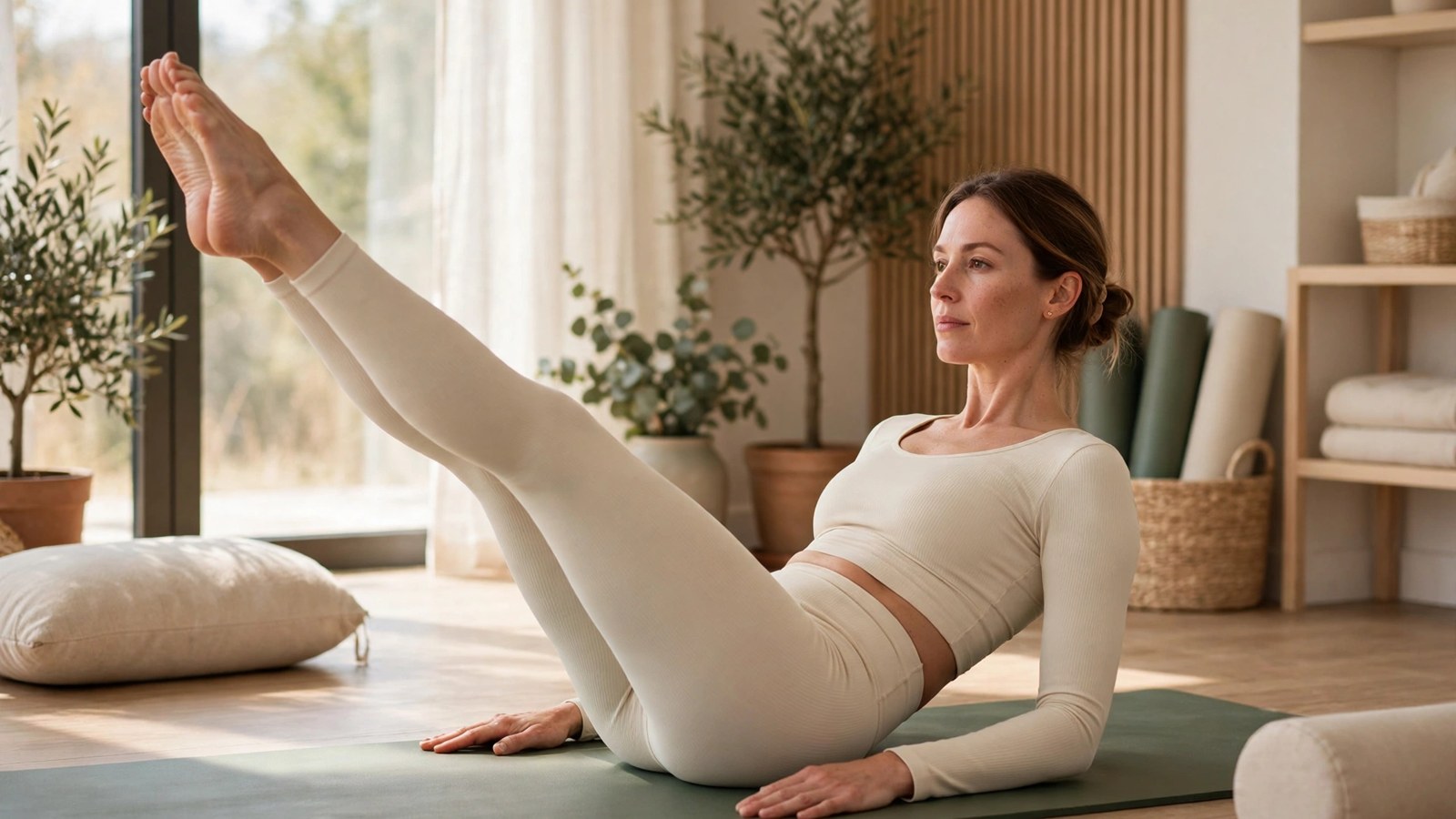
Start with one point for Pilates fabric: slow movement does not mean low demands. On the mat and on the reformer the range is wide and the holds are long. The fabric has to open slowly with the body, stay there, then come back, without showing through, slipping or digging in. Work through the four checks below on the sample itself.

Check one: how do you test close fit and follow?
Pilates tops and leggings sit close. The instructor needs to see where the effort is, and the wearer uses the wrap of the fabric to find position. Pull the sample both ways and let go. If it will not open across, leg lifts and side bends get pulled short first. If it does not follow lengthways, the waistband slides on roll-ups.
Use published styles to set the direction. Style 6602 40/40 shark skin fabric is 75% nylon and 25% spandex at 220 grams per square metre, listed for yoga products among its uses, and sits at the firmer wrap end. Style 6604 matte double-faced free-cut fabric is 81% nylon and 19% spandex at 165 grams per square metre, a lighter hand. Decide firm wrap or light first, then talk colours.
Check two: how do you test opacity under a slow stretch?
The risk in Pilates is not one fast squat. It is the bridge and leg-circle work, where the fabric is drawn out slowly and held. The longer it stays at full stretch, the clearer any show-through becomes. Pull a light-coloured sample to the point the garment will actually reach, put dark paper under it, hold for tens of seconds, then look. Do not pull and release at once and call it done.
Take extra care with white and pale shades. A dark shade passing says nothing about the pale one. On colourfastness, Maoxing Textile Dyeing states grade 3 only and does not state a higher grade.

Check three: what holds the support during a hold?
In slow work the fabric's job is not to snap back. It is to stay. Hold the sample open and watch the edges and the face: does an edge curl, does one area slacken first? Release it and watch how fast creases and pull marks fade. On the reformer, straps and springs draw the fabric the same way again and again, and the area that slackens first shows first on the garment.
Treat weight as a placing reference here, not a general standard. Bottoms that must hold are rarely chosen from the lightest cloth, while a breathable top should not be judged by a bottom's thickness. Place each body zone first, then check a specific style's weight and width on its own page.
Check four: how do you check skin feel and seams?
A class runs for tens of minutes, and the fabric stays on the skin longer than in many yoga sets. Rest the sample on the inner forearm, then run a fingertip over the face. The surface should feel flat, and on the garment the seams should stay clear of hip bones and shoulder blades, points that reformer work presses on. Free-cut routes can drop one binding step; style 6604 follows that route at 165 grams per square metre, 170 centimetres wide, in 156 colours, so check its edge behaviour first for close-fit styles.

Do not skip the wash recheck. Wash the sample once, then repeat check one and check two. A fabric that only opens up, or only starts to show through, after washing will not show it at sample stage. It shows after two wears of bulk garments.
The four checks in one table
| Check | Action | Fail sign |
|---|---|---|
| Follow | Stretch both ways, release | Will not open, poor return, waistband slips |
| Opacity | Hold at full stretch over dark paper | Pale shades show through, worse while held |
| Hold support | Hold open, watch edges and face | Curling edges, one area slackens, marks stay |
| Skin and seams | Rest on skin, press seam lines | Rough face, seams on bone, distortion after washing |

How do you sample and order Pilates fabric?
A4 hand-feel samples and colour card books are free. Cut samples cost CNY 20 per metre for quantities up to 3 kilograms and CNY 24 per metre above 3 kilograms; the sample charge is credited in full against a bulk order, and sample freight is prepaid by the buyer. Stock fabric has no minimum order quantity and colours can be combined; each style and colour keeps 1,600 metres in stock, and product prices are by inquiry only. Custom production starts at 150 kilograms per single colour, and orders below 150 kilograms can also be accepted; custom dyeing takes about 10 days. Payment is a 30% deposit with 70% against the copy of the bill of lading. Delivery supports EXW (Guangzhou) and FOB, and bulk prices exclude tax and freight.
Maoxing Textile Dyeing runs its own knitting mill and its own dye house, with more than 300 knitting machines and a daily output of 160 tonnes. The figures checked at sampling are the figures bulk production is checked against.
The images in this article are illustrative renderings. Colours and hand feel are confirmed on physical samples.
FAQ
What is the first check for Pilates clothing fabric?
Follow. Stretch the sample both ways and release it. If it does not come back cleanly, drop it, then check opacity, hold support, and skin feel and seams in order.
Why test Pilates fabric opacity while holding the stretch?
Pilates moves slowly and holds positions, and fabric is most likely to show through while held at full stretch. Holding a pale sample over dark paper is closer to wear than a quick pull.
Does Pilates clothing always need high spandex?
No. For a firmer wrap, look at style 6602 at 25% spandex. For a lighter hand, look at style 6604 at 19% spandex. Set the direction by body zone and movement first.
Can one fabric serve both Pilates tops and bottoms?
Place each zone first. Bottoms need hold support, tops need skin feel and breathability. Share one fabric only when it suits both.
What do Pilates fabric samples cost?
A4 hand-feel samples and colour card books are free. Cut samples cost CNY 20 per metre up to 3 kilograms and CNY 24 per metre above 3 kilograms, credited in full against a bulk order, with sample freight prepaid by the buyer.
Contact us
Maoxing Textile Dyeing supplies nylon spandex and polyester spandex stretch fabrics. Phone and WeChat: +86 13217533333; email: zhangzengwen@mail.gzmaoxing.com.