Quick answer: "Ice silk" is a market name for fabric that feels cool and slippery, not a fiber name you will find on a content label — generic fiber names are defined by GB/T 4146.1 (Textiles — Man-made fibres — Part 1: Generic names), where nylon is polyamide fibre, spandex is polyurethane elastic fibre, and "ice silk" is not on the list. So two "ice silk" fabrics can have completely different fiber content. Don't compare by name. Check the content label first: if it says nylon and spandex, it is a nylon spandex fabric, and you can compare hand feel, recovery and cooling touch from there.
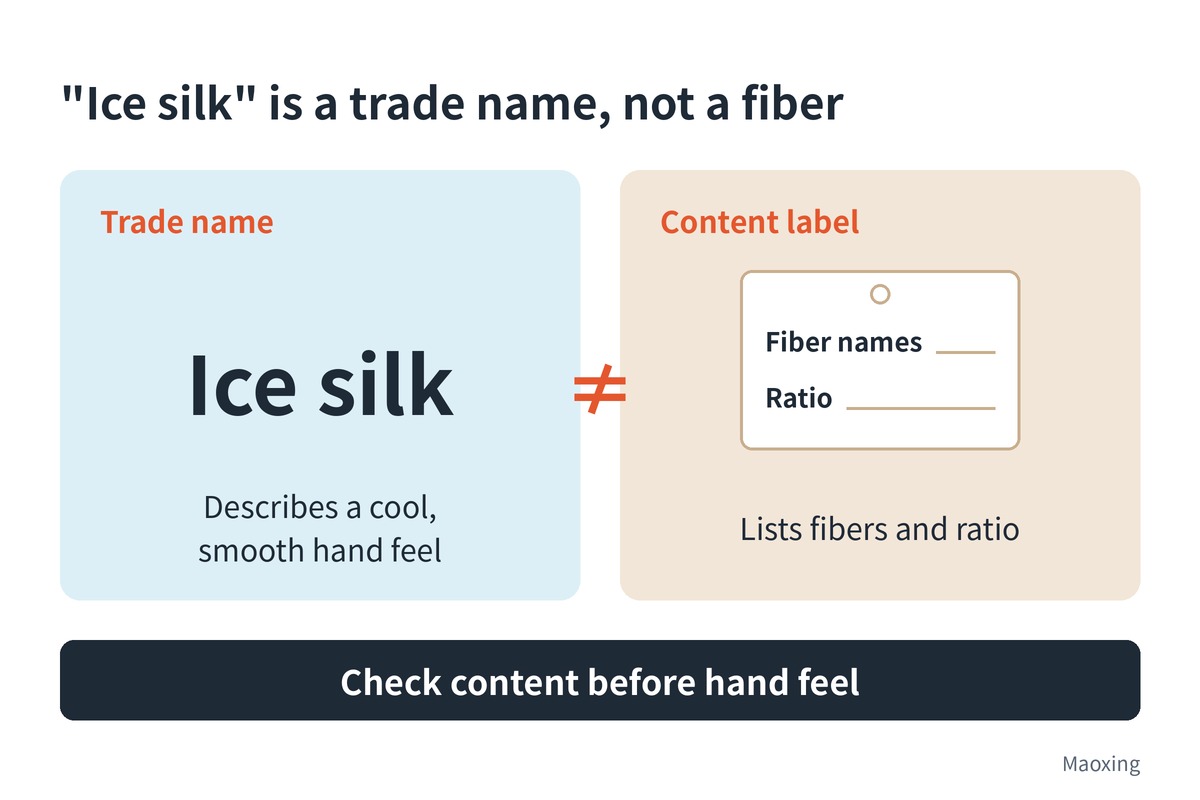
Is "ice silk" a fiber?
"Ice silk" is not a fiber; it is a sales name describing hand feel. Fabric content labels list fibers such as nylon (polyamide) and spandex (elastane) with their percentages, not "ice silk". So ice silk fabric and nylon spandex fabric are not two parallel categories: a fabric sold as ice silk may turn out to be nylon plus spandex, or something else entirely.
In practice, whenever a product list or swatch card says "ice silk", ask one more question: what is the fiber content, and in what ratio? Order by name alone and the bulk delivery can easily feel different from what you expected.
How do you compare ice silk fabric with regular nylon spandex?
Swap the name for checkable items: fiber content, hand feel, recovery, cooling touch and care.
| Item | Fabric sold as "ice silk" | Regular nylon spandex | How to check |
|---|---|---|---|
| What the name means | Market name for a cool, slippery feel | Named by content: nylon + spandex | Read the content label and ratio |
| Fiber content | Varies; read the label | Nylon (polyamide) + spandex | Get fiber names and ratio in writing |
| Hand feel | Usually sold on smoothness and coolness | Smoothness depends on yarn and knit | Handle both swatches side by side |
| Recovery | Depends on whether and how much spandex it contains | Spandex provides recovery | Stretch and watch it return |
| Cooling touch | A selling point with no naming standard | Can also be made with a cool feel | Touch and wear-test; check lab results if required |
| Care | Follows actual content | Avoid high heat; follow the care label for bleach and drying | Write the care label by content |
What does nylon contribute to ice silk type fabrics?
Nylon brings abrasion resistance and good elastic recovery, but it creases under small forces. The China Cotton Textile Association's textile knowledge explainer says nylon (polyamide) has good abrasion resistance and good elasticity and recovery. The same source notes that nylon deforms and creases easily under small forces, and that its moisture absorption is relatively good among synthetic fibers, making it a little more comfortable to wear than polyester.
If an ice silk fabric contains nylon, you can expect nylon's durability and comfort, and its creasing comes along too. For close-fitting garments and bedding, crumple the swatch and see how well the surface recovers.
Related: Why nylon spandex snags and pills
Spandex drives recovery: should you check it in ice silk fabric?
Yes; whether an ice silk fabric stretches and recovers well depends mainly on its spandex content. China's textile industry standard FZ/T 54010-2014 (Elastane filament yarns) defines elastane filament as a polyurethane elastic fiber that quickly returns to roughly its original length after stretching. That elasticity is why nylon spandex snaps back after stretching.
For ice silk fabric that contains spandex, follow the care label. GB/T 8685-2008 (Textiles – Care labelling code using symbols) sets the bleach, drying and ironing symbols: skip chlorine bleach when the label says "do not bleach" or "only oxygen/non-chlorine bleach", keep it out of strong sun when it says "line dry in the shade", and set the iron by the number of dots.
Related: How to care for nylon spandex fabric
How do you judge the cooling touch of ice silk fabric?
Judge cooling touch by handling and wear-testing, not by the name. "Ice silk" describes an impression, and fabrics with different content from different mills can feel quite different.
Put an ice silk swatch next to a regular nylon spandex swatch, touch both, hold them against the inside of your forearm, and check again after sweating.
If your customer has a firm cooling requirement, ask the supplier for relevant test results and rely on the lab report; without one, treat cooling as a hand-feel description and keep it out of finished-garment performance claims.
Related: How to choose fishing shirt fabric
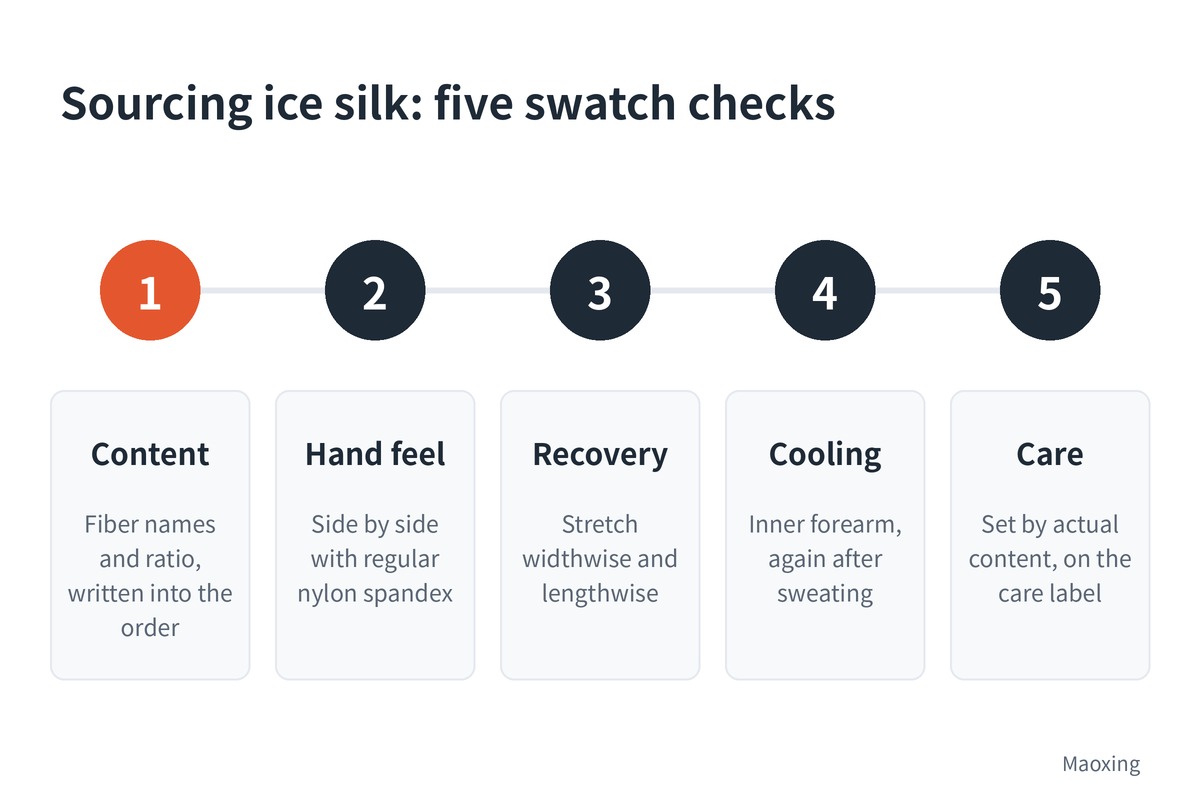
What steps should you follow when sourcing ice silk fabric?
Follow five steps: content, hand feel, recovery, cooling touch, care.
- Content: read fiber names and ratio on the label or swatch card, and put them in the order.
- Hand feel: compare side by side with a regular nylon spandex swatch for smoothness and weight.
- Recovery: stretch widthwise and lengthwise and see whether it returns to shape.
- Cooling touch: hold it against your inner forearm, and touch it again after sweating.
- Care: set ironing, drying and bleach rules by actual content and put them on the care label.
At Maoxing Textile Dyeing, we have worked with nylon spandex at Zhongda, Guangzhou, for 15 years, with our own knitting mill and our own dye house. When buyers come in asking for "ice silk", we first ask what garment they are making and how much stretch they need, then compare hand feel and recovery against our nylon spandex swatches. Keep the market name if you like, but write the fiber content into the order.
Related: How to choose nylon spandex fabric at Zhongda Textile Market
FAQ
1. Is ice silk the same as nylon?
Not necessarily; ice silk is a name, so read the content label. Some ice silk fabrics are nylon plus spandex and some are not; the fiber names and ratio on the label decide.
2. Is ice silk fabric cooler than regular nylon spandex?
It depends; compare swatches. Cooling touch relates to fiber, yarn and knit, not to the name; if it is a firm requirement, rely on a lab report.
3. Does ice silk fabric crease easily?
If it contains nylon, watch for creasing. Nylon deforms and creases under small forces, so crumple the swatch and check how it recovers.
4. Can ice silk fabric be ironed?
Go by the actual content. For nylon spandex, use a low iron setting (nylon has only moderate heat resistance, and nylon spandex follows nylon); most garments hang smooth without ironing.
Sources
- Nylon has good abrasion resistance; good elasticity and recovery, deforms and creases under small forces; relatively good moisture absorption among synthetics, a little more comfortable than polyester; moderate heat resistance, iron on low. China Cotton Textile Association, textile knowledge (explainer material, not a national or industry standard), http://www.ccta.org.cn/fszz/fzzsxx/rs/202104/t20210429_4136415.html , checked 2026-10-26.
- Elastane filament is a polyurethane elastic fiber that quickly returns to roughly its original length after stretching is released. FZ/T 54010-2014, Elastane filament yarns (textile industry standard, recommended; issued by the Ministry of Industry and Information Technology; replaces FZ/T 54010-2006), National Public Service Platform for Standards Information, https://std.samr.gov.cn/hb/search/stdHBDetailed?id=8B1827F181F4BB19E05397BE0A0AB44A , status: current, checked 2026-10-28.
- Bleach symbols cover "any bleaching agent allowed", "only oxygen/non-chlorine bleach allowed" and "do not bleach"; natural drying symbols include "line drying in the shade"; dots inside the iron symbol give the maximum sole-plate temperature. GB/T 8685-2008, Textiles – Care labelling code using symbols (national standard, recommended; modified adoption of ISO 3758:2005), National Public Service Platform for Standards Information, https://std.samr.gov.cn/gb/search/gbDetailed?id=71F772D77659D3A7E05397BE0A0AB82A , status: current (confirmed valid at review on 2022-01-21), checked 2026-10-28.
- Terminology follows the current national standard. GB/T 4146.1-2020, Textiles - Chemical fibres - Part 1: Generic names (current; modified adoption of ISO 2076:2013; issued 2020-10-21, effective 2021-05-01; National Public Service Platform for Standards Information), https://std.samr.gov.cn/gb/search/gbDetailed?id=B2142F28B4EF5E32E05397BE0A0ABFA9 , checked 2026-11-09.
Maoxing Textile Dyeing | nylon spandex weft-knitted fabrics Stall 16-18, North 5th Street, Zhongda Jiangnan Textile City, Haizhu District, Guangzhou, China WhatsApp: +86 159 1896 4057 Email: zhangzengwen@mail.gzmaoxing.com Web: https://www.gzmaoxing.com/en/ Open daily 09:00-19:00; please message before visiting.