Blog
How to Choose Lingerie Fabric: Nylon Spandex Essentials for Skin Feel, Recovery, Breathability, and Common Mistakes
Lingerie fabric has three tests to pass: next-to-skin feel, stretch recovery and breathability. Nylon spandex (polyamide elastane) knits feel smooth and snap back quickly, so they work for bras, briefs and seamless styles. Their weak spots are just as clear: snagging, heat sensitivity and weaker light resistance. Match stretch and weight to each body zone, run recovery, wet/dry opacity and edge-curl checks on samples, and seal an approved sample before bulk.
Why is nylon spandex so common in lingerie?
Nylon spandex pairs a smooth next-to-skin hand with strong stretch recovery, which is why it is a go-to for intimate layers. Also called polyamide elastane or nylon-elastane knit, it combines nylon filament with spandex (elastane / elastic fiber). Nylon brings the fine, slick touch; elastane brings stretch and recovery (snap-back).
Compared with polyester spandex, the polyamide blend feels softer and rubs less against skin. At Maoxing we have focused on these weft knits at Zhongda, Guangzhou for 15 years, and next-to-skin styles are where most of the requests we get land.
What should you check for skin feel?
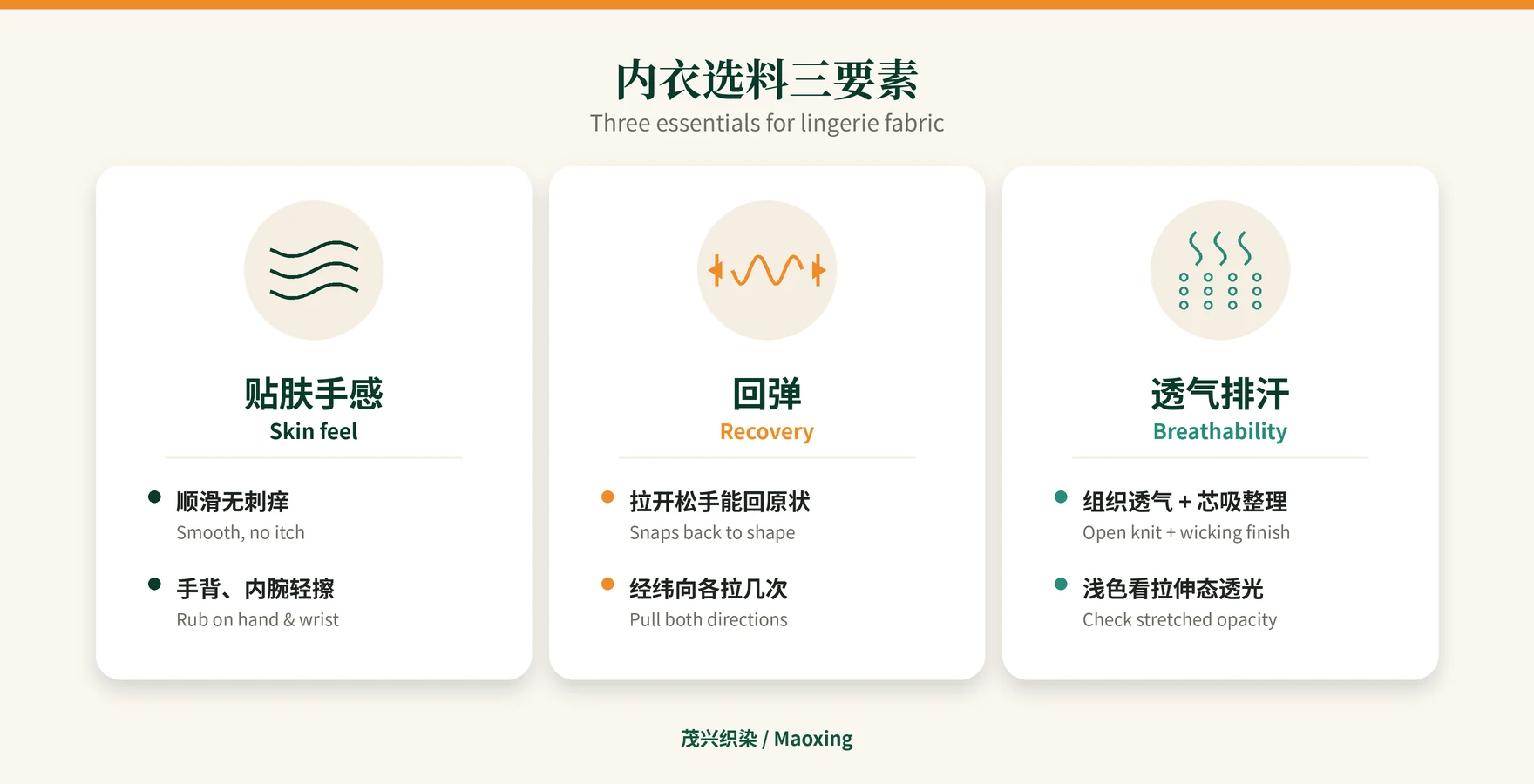
Skin feel depends on yarn fineness, surface finish and softening treatment, not just on whether it "feels soft." Next-to-skin hand (skin comfort / handfeel) comes from filament denier, knit structure and finishing. Finer filaments feel smoother; matte versus semi-dull changes both the look and the touch.
Rub the swatch on the back of your hand and the inner wrist and check for itch, drag or static. Then scrub it a few times and see whether the face fuzzes.
How do you judge recovery?
Good recovery means the fabric returns to shape quickly after stretching; slack or slow return is a red flag for lingerie. Recovery (elastic recovery / snap-back) decides whether a garment bags out over time.
Stretch the sample lengthwise and widthwise, let go, and watch the speed and any stretch marks; repeat several times. Bra bands, strap joins and brief waistbands carry the most load. Elastane ratio and covering method both affect stretch recovery, so confirm on the actual approved sample.
How do you balance breathability and moisture management?
Breathability comes from knit structure; moisture wicking comes from finishing and fiber cross-section, and both should be chosen by use case. Moisture wicking (quick-dry / sweat transport) matters for sports bras and summer briefs; mesh, jacquard or lighter knits improve breathability (air permeability).
Drop water on the swatch and watch how fast it spreads, then hold it to the light to read the density. Lighter fabric covers less, so test pale shades stretched.
Scenario comparison table
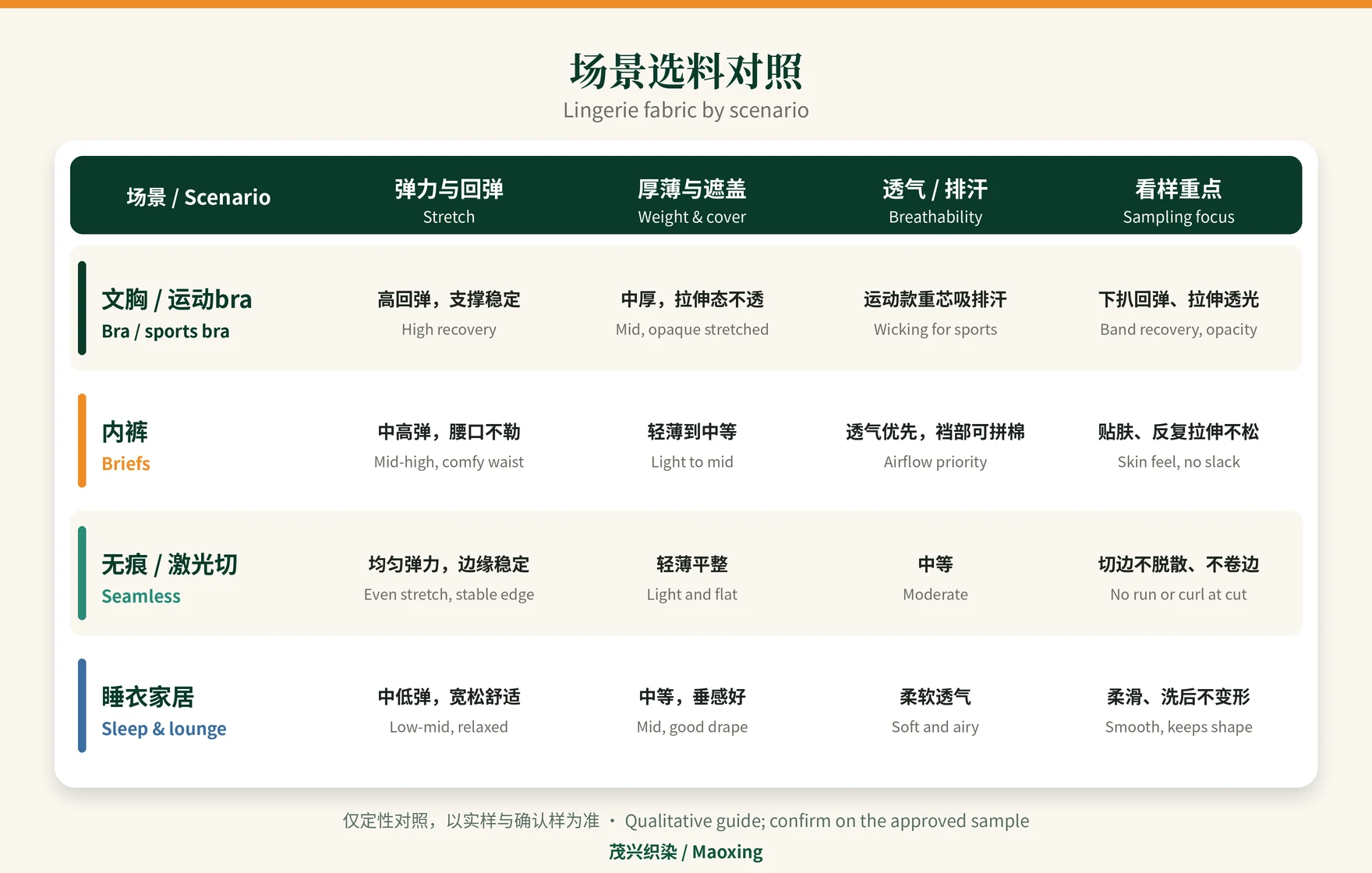
Each lingerie category weighs stretch, weight and airflow differently, so pick fabric scenario by scenario.
| Scenario | Stretch & recovery | Weight & cover | Breathability / wicking | Sampling focus |
|---|---|---|---|---|
| Bra / sports bra | High recovery, stable support | Mid weight, opaque when stretched | Wicking for sports styles | Band recovery, stretched opacity |
| Briefs | Mid-high stretch, comfy waist | Light to mid | Airflow first; cotton gusset optional | Skin feel, no slackness after pulls |
| Seamless / laser-cut | Even stretch, stable edges | Light and flat | Moderate | Clean cut edges, no curl or run |
| Sleep & loungewear | Low-mid stretch, relaxed | Mid, good drape | Soft and airy | Smooth hand, shape after washing |
What are the weak spots, and how do you avoid them?
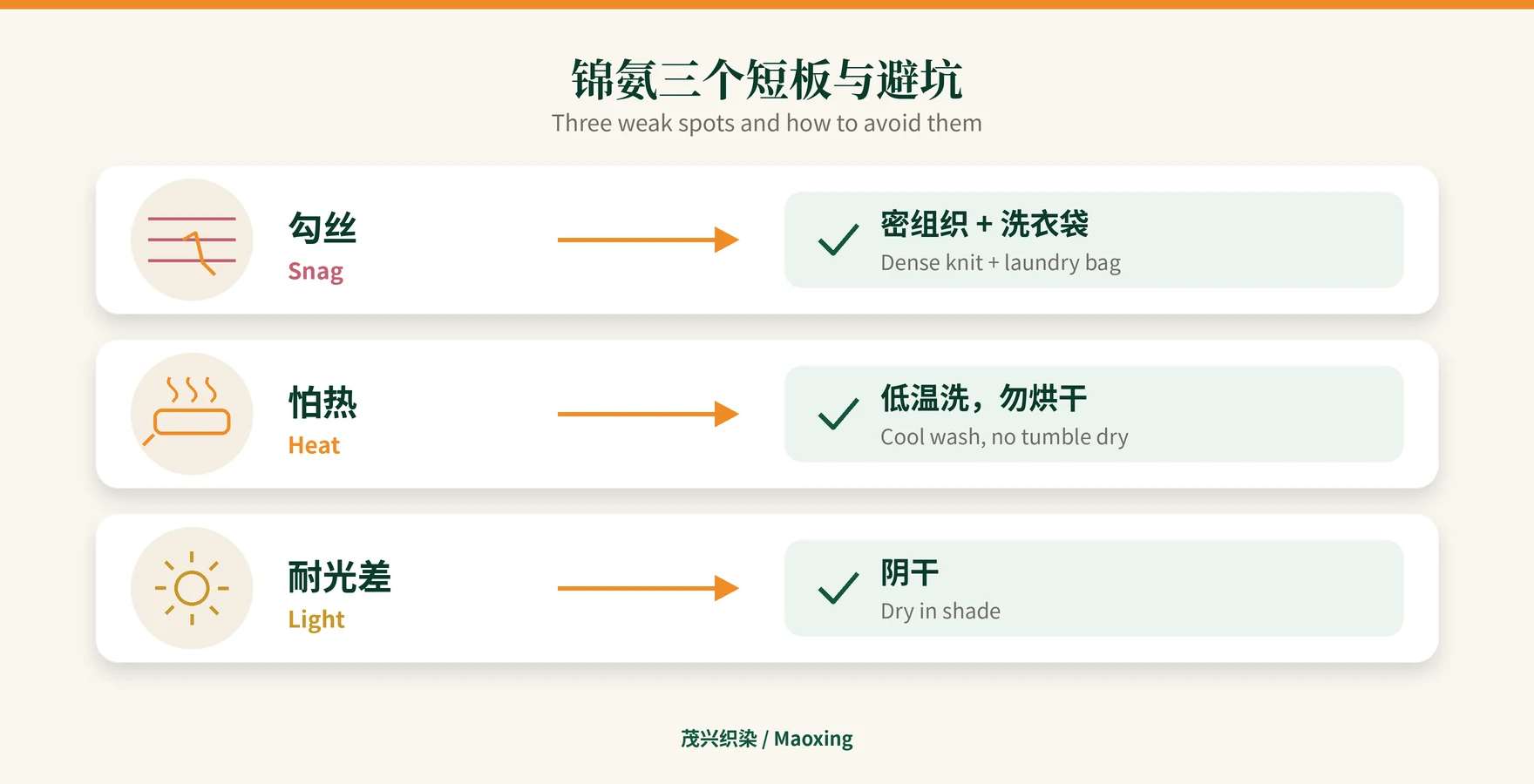
Nylon-elastane has three honest weak spots: snagging, low heat tolerance and weaker light resistance. Each one can be managed through design and care.
Snagging (snags / pulled threads): fine filament knits catch on nails, hook-and-loop and jewelry. Choose denser knits, keep Velcro out of the same wash, and recommend a laundry bag.
Heat sensitivity: hot ironing or tumble drying ages elastane and stiffens the face; control heat-setting and bonding temperatures and label "cool wash, do not tumble dry." Light fading (sun yellowing): whites and pastels yellow under long sun exposure; advise shade drying and agree colorfastness terms in the order.
Common mistakes
The usual mistake is deciding on hand feel alone and overlooking recovery, cover and dye lots.
- Softer is always better: too soft can mean weak recovery, and the garment slackens after a few wears.
- Thinner is always more breathable: it is also more see-through once stretched.
- More elastane is always better: high ratios can feel tight without giving better snap-back.
- Checking only at rest: lingerie is worn stretched, so test it stretched.
- Mixing stock shades freely: panels from different lots may not match; seal approvals and agree dye-lot tolerance (shade variation).
- Any fabric for seamless: laser cutting needs knits whose edges do not run or curl.
FAQ
1. Polyamide elastane or polyester elastane for lingerie?
Polyamide elastane feels softer and smoother next to skin and is used more for intimate layers; polyester blends are crisper with better light resistance. Choose per garment zone.
2. Does lingerie need a very high elastane ratio?
No. Set stretch by zone; recovery also depends on covering and knit, so go by hand-pull tests on the swatch.
3. How can I reduce snagging?
Pick denser knits, wash away from Velcro and zippers, use laundry bags, and keep abrasive trims to a minimum.
4. Can this fabric be ironed hot?
Avoid it. Both nylon and elastane dislike high heat, so use low heat or a press cloth, and label "do not tumble dry."
5. Why do white bras turn yellow?
Sun, heat, and sweat residue are common causes. Dry in shade and agree light-fastness terms upfront.
6. What matters most for sports bras?
High recovery, moisture wicking and opacity when stretched, plus shape retention after repeated pulls.
7. What fabric suits seamless lingerie?
Even-stretch knits with stable edges that do not run or curl after laser cutting. Test-cut the swatch to check.
8. Can small orders get custom colors?
Custom orders (new production / custom colors): minimum 150 kg per color; orders below 150 kg are also accepted. Ready stock: no minimum order quantity; colors can be combined. With our own dye house, custom dyeing typically takes about 10 days, confirmed on the order.
Maoxing Textile Dyeing | nylon spandex weft-knitted fabrics Stall 16-18, North 5th Street, Zhongda Jiangnan Textile City, Haizhu District, Guangzhou, China Phone: +86 13217533333, WeChat: A13217533333 WhatsApp: +86 159 1896 4057 Email: zhangzengwen@mail.gzmaoxing.com Web: https://www.gzmaoxing.com/en/ Open daily 09:00-19:00; please confirm before visiting.