Blog
How Do You Place a Bulk Order for Nylon Spandex Fabric? From Approved Sample to Fabric Inspection
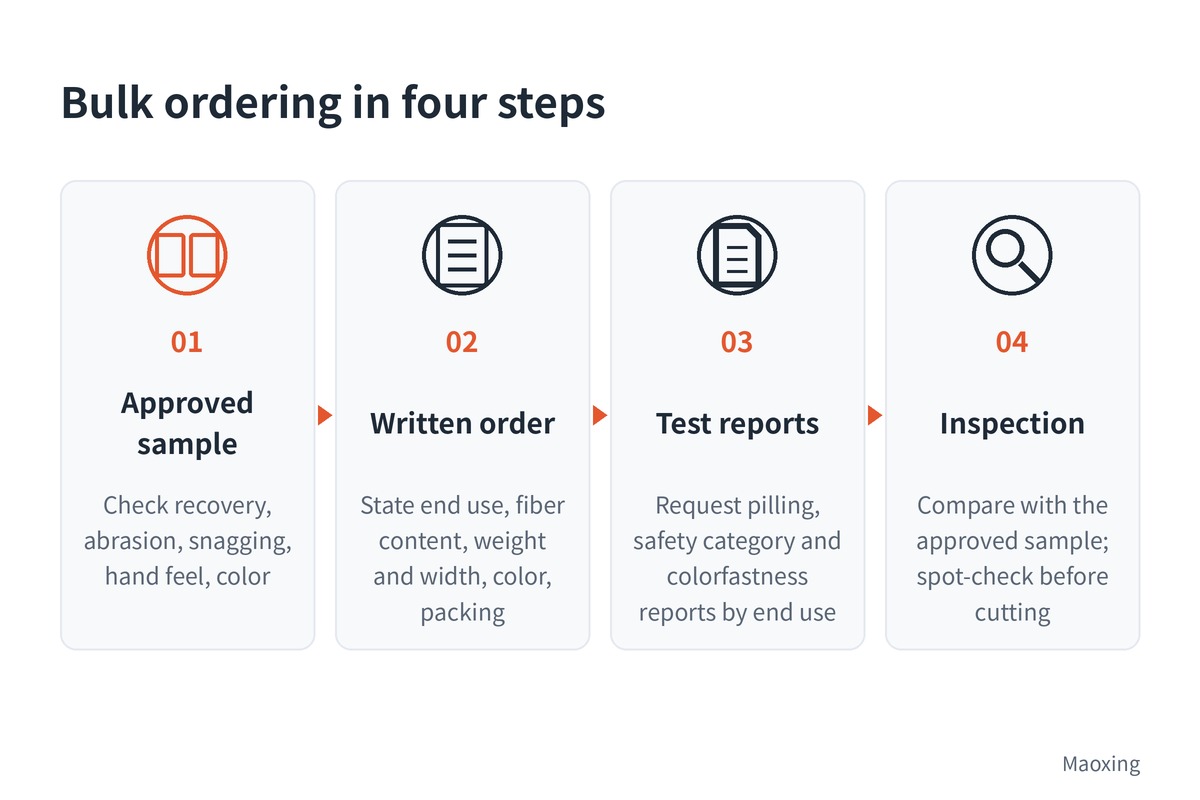
When bulk fabric arrives and the hand feel or color does not match the swatch, the order usually left the approved sample and requirements loose. A bulk order for nylon spandex fabric (nylon + elastane) takes four steps: approve a sample for recovery, abrasion, snagging, hand feel and color; write end use, fiber content, weight and width, color and report requirements into the order; attach test reports for intimate wear and swimwear; and inspect the delivered fabric against the approved sample before cutting.
Every step should rest on the approved sample and written terms; verbal agreements do not count.
Maoxing Textile Dyeing has been making nylon spandex fabric at Zhongda, Guangzhou for 15 years, with our own knitting mill and our own dye house, and we run bulk orders in this same order. Below is what buyers should do at each step.
Related: How to sample nylon spandex fabric
What is the bulk ordering process for nylon spandex?
The process runs approved sample → written order → test reports → inspection, and you should not move on until the previous step is settled.
| Step | What the buyer does | What to keep on record |
|---|---|---|
| 1. Approved sample | Check recovery, abrasion, snagging, hand feel, color | Signed approved sample, one copy each side |
| 2. Written order | State end use, fiber content, weight and width, color, packing | Written purchase order |
| 3. Test reports | Request pilling, safety category and colorfastness reports by end use | Test reports |
| 4. Inspection | Compare with the approved sample; spot-check before cutting | Inspection record |
What should the approved sample confirm before a bulk order?
The approved nylon spandex sample should confirm recovery, abrasion, snagging, hand feel and color, and it becomes the reference for the bulk. Nylon has good elasticity and recovery and abrasion performance to be confirmed by a corresponding sample test report, which is why nylon spandex suits leggings and sports bras. Nylon also deforms and wrinkles easily under small forces, so stretch the sample in both directions several times and watch how it recovers.
Abrasion resistance does not mean snag resistance. Lightly scratch the sample with a fingernail or a rough object to see whether yarns pull out.
For color, match and sign off the approved sample; the bulk is then matched to it.
Related: Why nylon spandex snags and pills
What should a nylon spandex bulk order specify?
A nylon spandex bulk order should put end use, fiber content, weight and width, color and report requirements in writing; anything left vague becomes a dispute later.
- End use: yoga wear, sports bras, swimwear, lingerie, sun-protection wear, fitted sheets or menswear.
- Fiber content ratio: same as the approved sample, and consistent with the label and report.
- Weight and width: as on the approved sample and your cutting plan.
- Color: per the signed approved sample.
- Reports: which items and which standards (see next section).
- Packing and shipping marks: per your warehouse requirements.
Leave out vague wording such as "similar hand feel" or "close color". At inspection, what would you check it against?
Should a nylon spandex bulk order come with test reports?
Yes for intimate, infant and swimwear uses; choose report items by end use.
| End use | Suggested reports | Standard |
|---|---|---|
| Lingerie, swimwear, fitted sheets (skin contact) | Safety category (at least B), formaldehyde, pH | GB 18401-2010 |
| Infant products | Safety category A | GB 18401-2010 |
| Yoga and sportswear | Pilling grade | GB/T 4802.1-2008 |
| Swimwear | Colorfastness to chlorinated water | GB/T 8433-2013 |
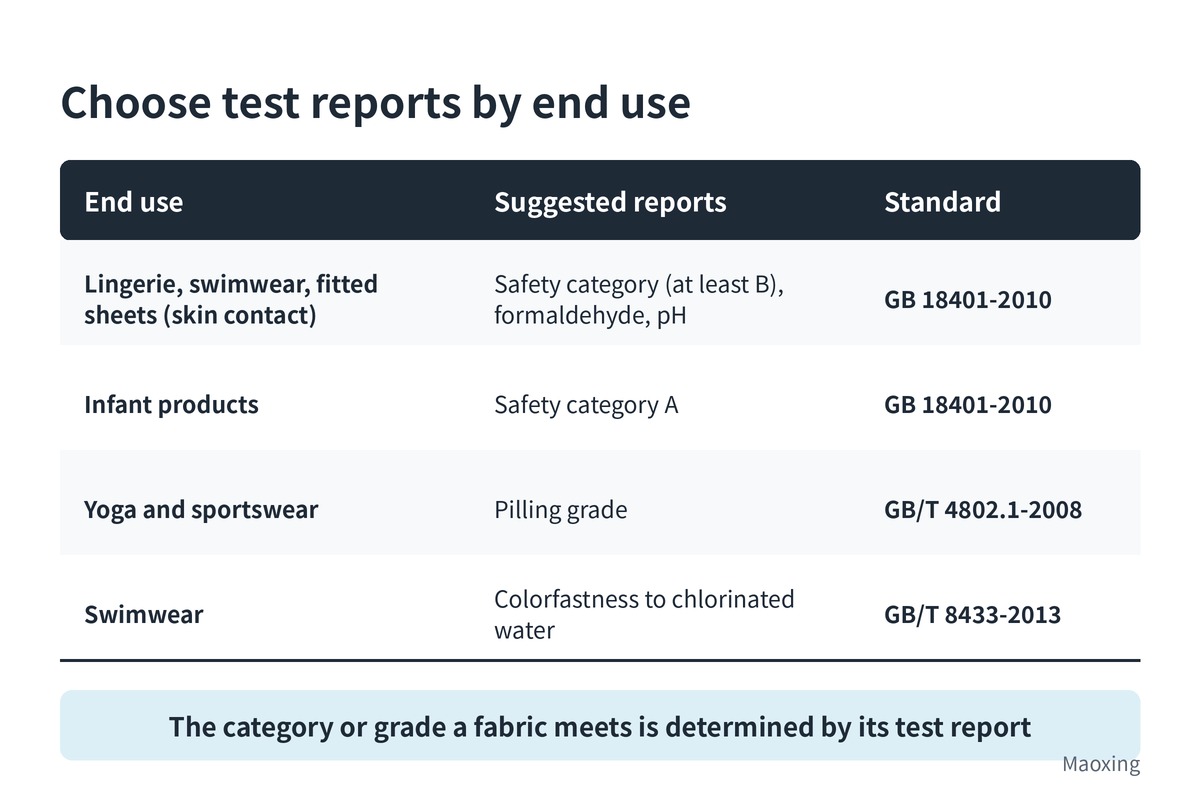
GB 18401-2010, National general safety technical code for textile products, divides textiles into Categories A, B and C: infant products must meet Category A, products in direct skin contact at least B, and others at least C; the label must state the category. Formaldehyde limits are ≤20, ≤75 and ≤300 mg/kg for A, B and C; pH ranges are 4.0-7.5, 4.0-8.5 and 4.0-9.0.
Under GB/T 4802.1-2008 (circular locus method), pilling is graded 1 to 5: grade 5 no change, 4 slight, 3 moderate on part of the surface, 2 distinct over most of the surface, 1 dense over the whole surface. A higher grade means better pilling resistance. The category or grade a fabric meets is determined by its test report.
How do you inspect a nylon spandex bulk delivery?
Spot-check the delivery against the approved sample first and cut only after it passes; do not cut first and argue later.
- Fiber content, weight and width match the order.
- Recovery: stretch and release, compare with the approved sample.
- Surface: snags, holes, stains.
- Color: side by side with the approved sample, a quick check is enough.
- Reports: all required reports arrived with the goods.
Keep nylon spandex's two weak points in mind during inspection: nylon's heat resistance and light resistance are poor. Do not press the fabric with a hot iron, and keep rolls somewhere the sun does not reach. Garment care instructions follow the symbols in GB/T 8685-2008, Textiles - Care labelling code using symbols.
Related: How to care for nylon spandex fabric Related: How to choose fishing shirt fabric
FAQ
Does the approved sample have to be signed?
Yes. The signed approved sample is the reference for bulk inspection; each side keeps one so any disagreement can be checked against it.
Can I skip test reports for a bulk order?
For outerwear without skin contact it depends on your needs; for intimate wear and swimwear, request reports. Under GB 18401-2010 direct skin contact needs at least Category B, confirmed by the report.
What pilling grade should the order state?
Set it by end use and customer requirement, and write both the grade and the standard GB/T 4802.1-2008 into the order. "No pilling" cannot be verified.
What if I find snags during inspection?
Stop cutting, photograph the location and count, and raise it with the supplier against the approved sample and order. Nylon spandex snags easily, so keep cutting tables smooth and remove jewelry.
Sources
- Nylon strength and abrasion resistance; elasticity and recovery; easy deformation and wrinkling; poor heat and light resistance. China Cotton Textile Association, textile knowledge, http://www.ccta.org.cn/fszz/fzzsxx/rs/202104/t20210429_4136415.html , checked 2026-10-26.
- GB/T 4802.1-2008, Textiles - Determination of fabric propensity to surface fuzzing and to pilling - Part 1: Circular locus method.
- GB 18401-2010, National general safety technical code for textile products (Categories A/B/C, scope, formaldehyde limits, pH ranges).
- GB/T 8685-2008, Textiles - Care labelling code using symbols, https://std.samr.gov.cn/gb/search/gbDetailed?id=71F772D77659D3A7E05397BE0A0AB82A , current.
- GB/T 8433-2013, Textiles - Tests for colour fastness - Colour fastness to chlorinated water (swimming-pool water), https://std.samr.gov.cn/gb/search/gbDetailed?id=71F772D7EEF0D3A7E05397BE0A0AB82A , current.
Maoxing Textile Dyeing | Nylon spandex stretch fabrics Stall 16-18, North 5th Street, Zhongda Jiangnan Textile City, Haizhu District, Guangzhou WhatsApp: +86 15918964057 Email: zhangzengwen@mail.gzmaoxing.com Web: gzmaoxing.com