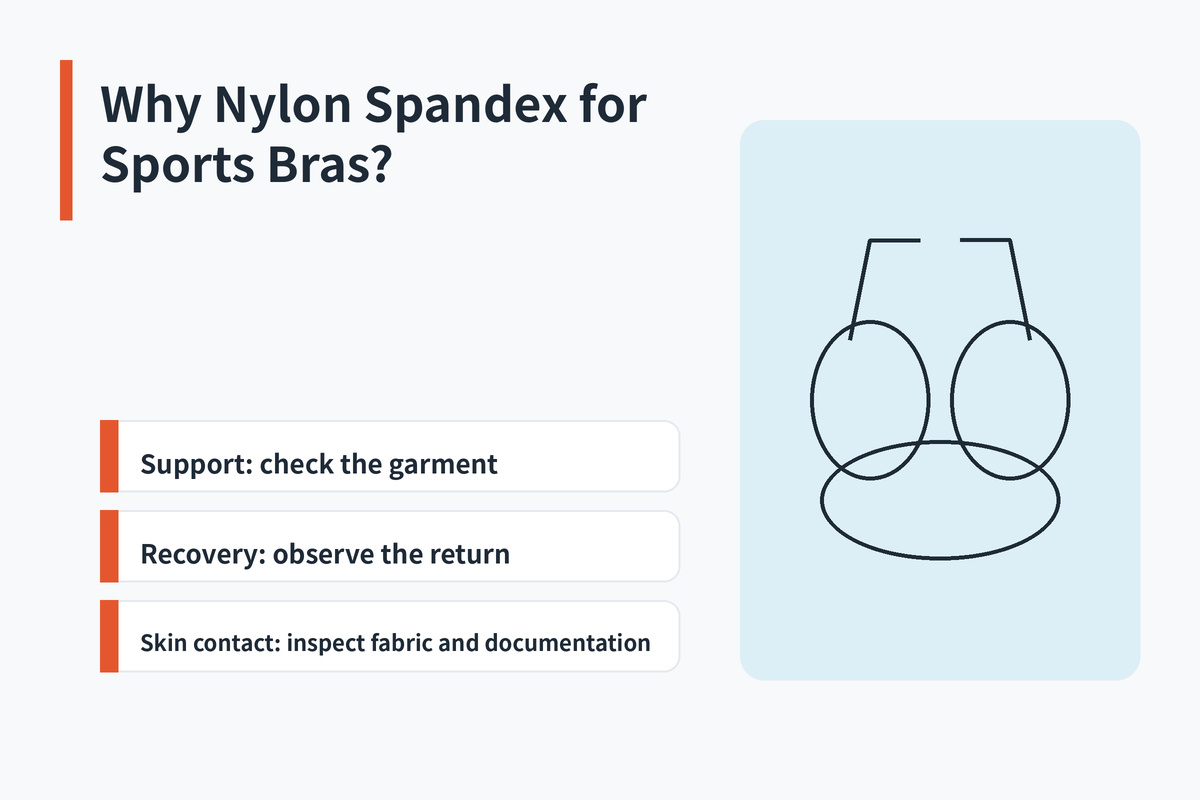
A swatch that stretches easily and snaps back does not mean the finished sports bra will support well. Nylon spandex is worth considering for sports bras for nylon's abrasion resistance, elastic recovery and moisture absorption, but support still needs checking in a finished garment. Also called polyamide elastane, nylon spandex should be assessed by garment zone: underband, strap joins and skin-contact layer.
Record recovery, local comfort, pilling performance and safety documentation separately.
What makes nylon spandex a candidate, and what does composition not prove?
Nylon spandex can be a sports-bra fabric candidate, but its fiber name does not establish garment support or wearing comfort.
China Cotton Textile Association educational notes describe nylon as strong and abrasion-resistant, with good elasticity and recovery. They describe its moisture absorption as relatively good among synthetics and its wearing comfort as somewhat better than polyester. These are qualitative fiber descriptions, not test results for a particular finished blend.
- Abrasion resistance is not a no-pilling promise. Check a report for the selected finished fabric separately.
- Moisture absorption is not quick drying. The educational notes do not establish measured wicking, air permeability or drying performance for a sports bra.
- Elastic recovery is not a support rating. Watching a swatch recover does not determine which exercise intensity a garment suits.
At Maoxing Textile Dyeing, we have worked with nylon spandex fabric at Guangzhou Zhongda for 15 years, with our own knitting mill and our own dye house. When we talk sports-bra fabric with buyers, we suggest keeping two columns: what the fabric evidence establishes, and what still needs a garment trial.
Which garment zones make support questions more useful?
Check support at the underband, strap joins and front panel rather than asking only whether the whole fabric stretches.
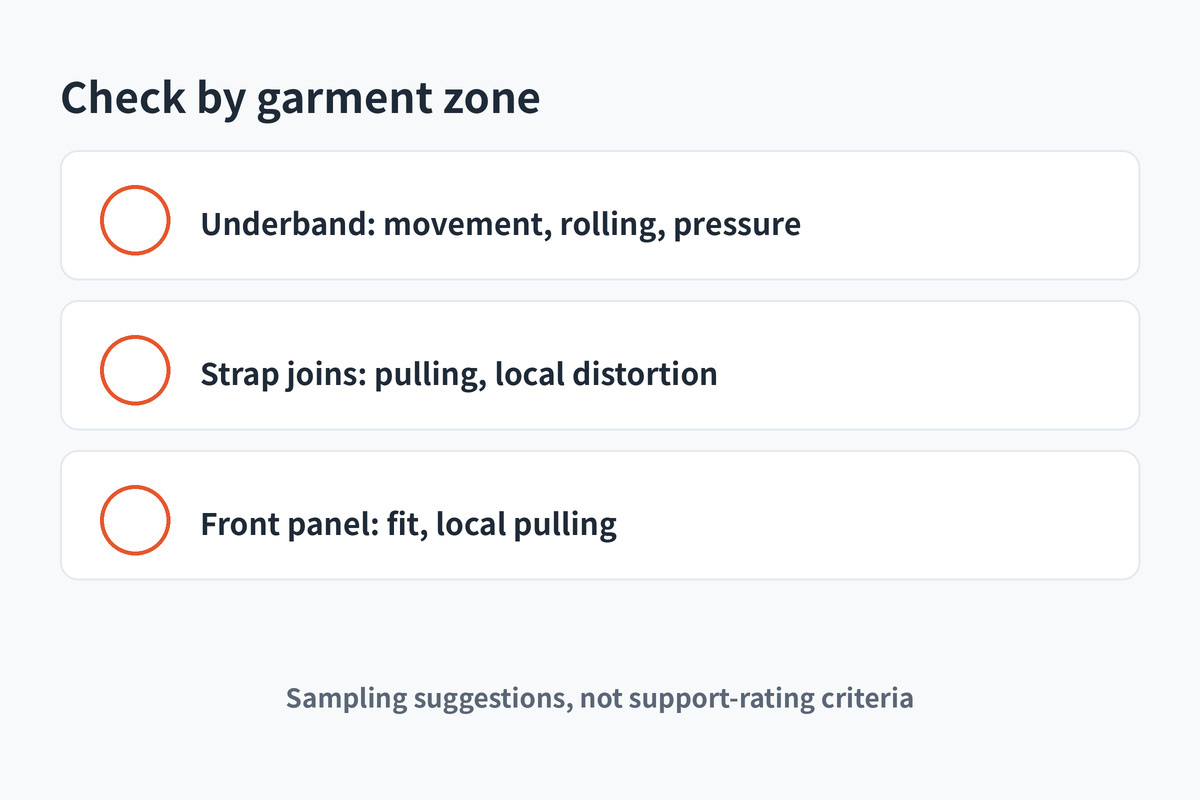
The following are sampling and fitting suggestions, not a support test method or pass criteria. Keep pattern, size and component configuration consistent when comparing fabrics; once the construction changes, not every difference can be blamed on the fabric.
- Underband: mark its position on the sample garment, raise and lower the arms, and record riding up, rolling or uncomfortable pressure. Investigate both fabric choice and band construction if a problem appears.
- Strap joins: observe pulling and local fabric distortion during movement. A hand stretch of the body fabric does not replace checking the join.
- Front panel: record fit and local pulling during movement against the intended use. A thick hand or tight feel alone does not establish suitable support.
Related: Choosing yoga fabric by practice
What do stretching, releasing and fitting actually tell you?
Hand stretching can screen recovery differences, while garment fitting checks local fit and comfort; neither replaces the other.
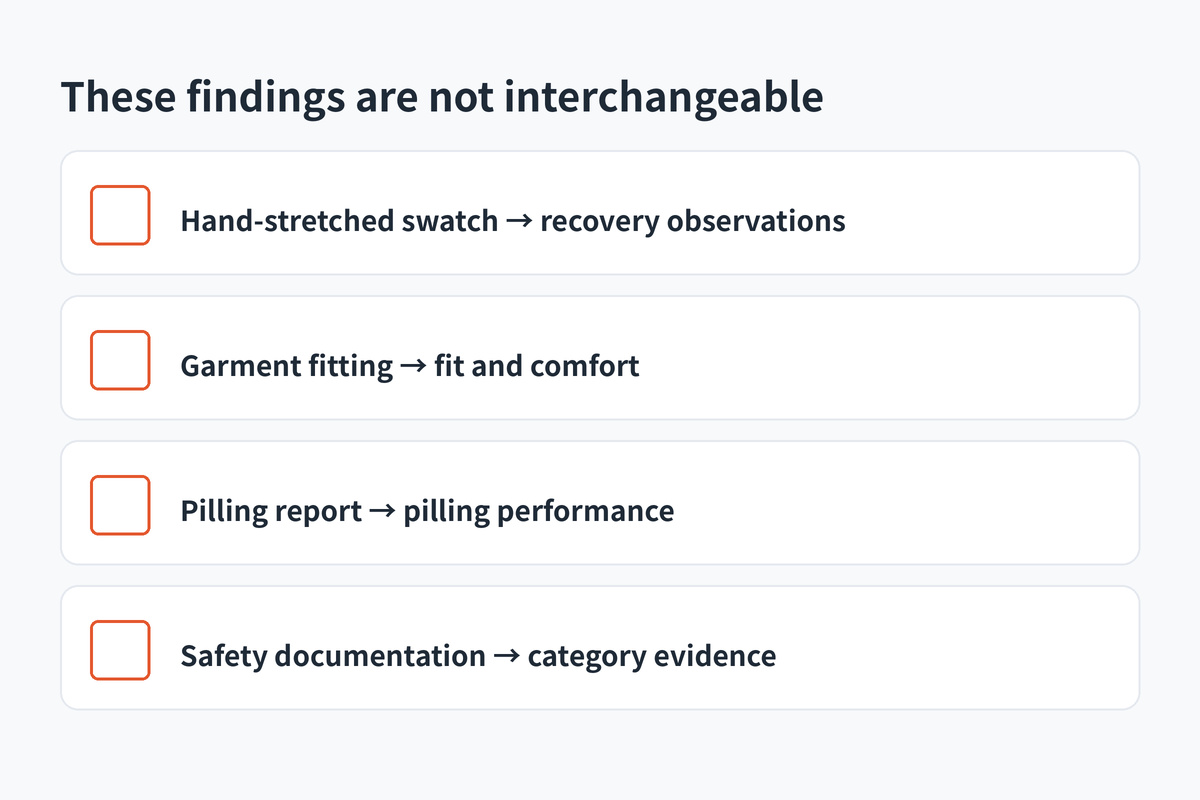
| Check or document | What to record | What it does not establish | Next step |
|---|---|---|---|
| Stretch a swatch in a consistent direction and release | Whether it lies flat or retains marks | Support rating or numerical recovery rate | Record direction and observations; compare candidates consistently |
| Move in garments of the same pattern | Band movement, strap pulling, local pressure | That fabric alone caused a problem | Investigate fabric and construction separately |
| Feel the skin-contact face and inspect seams | Roughness, drag or local rubbing | Safety category or wicking performance | Continue checking the actual garment lining and seams |
| Review a pilling report | Pilling grade under the stated method | No-pilling promise or support performance | Check that the report matches the selected fabric |
| Review safety documentation | Evidence for the relevant category | That a soft hand means compliance | Check garment labeling against relevant documentation |
The China Cotton Textile Association educational notes also say nylon deforms and creases easily under small forces. Record the conditions when a sample shows creases or distortion; a fiber's recovery characteristics do not guarantee that every finished fabric will lie flat again.
What evidence should you keep for skin-contact and rubbing zones?
Keep comfort observations and safety evidence for the skin-contact layer, and check pilling performance separately for rubbing zones.
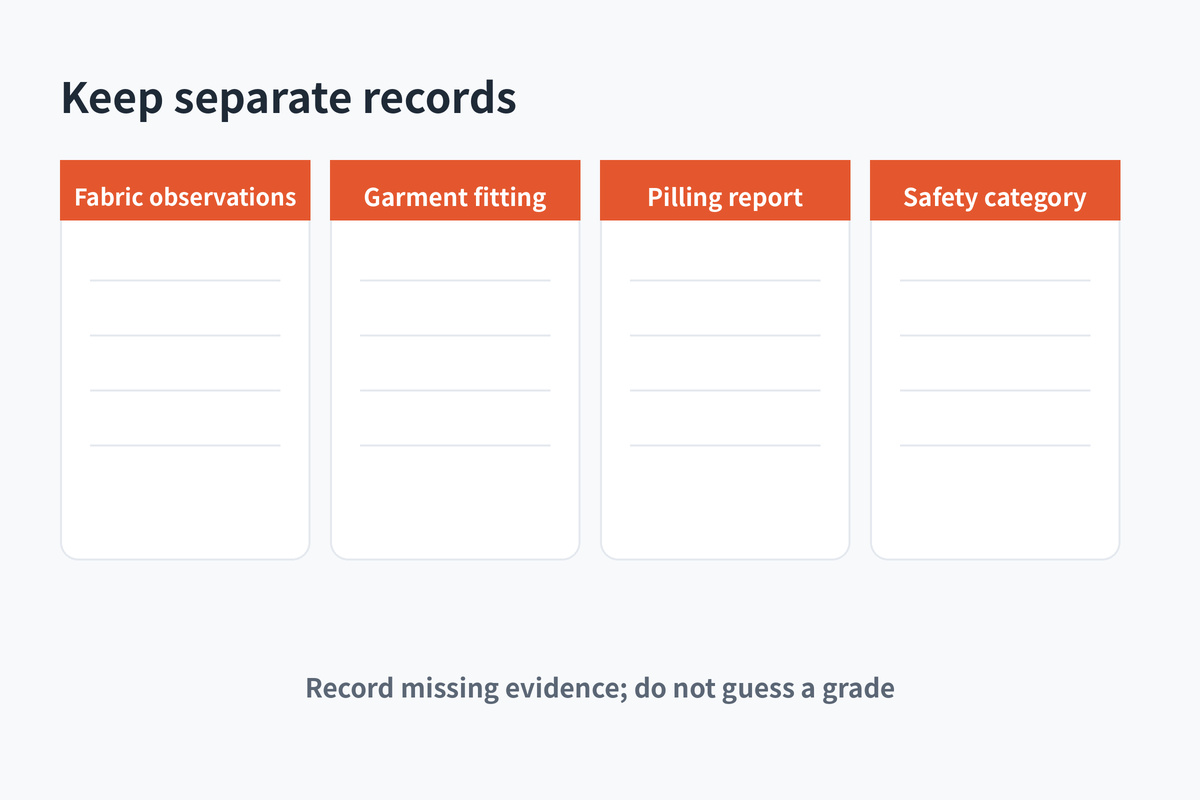
- Examine the actual skin-contact layer. Identify the face worn against skin, inspect fabric and seams, then check local discomfort around the underband and underarm in a garment trial. Subjective hand comparisons do not replace safety tests.
- Check safety category documentation. Under GB 18401-2010, products in direct contact with skin must meet at least category B, and the label must state the category. Review relevant test documentation; do not assign an unverified category to a fabric or garment.
- Check the corresponding pilling report. GB/T 4802.1-2008, the circular locus method, grades pilling from 1 to 5: grade 5 means no change, 4 slight, 3 moderate in some areas, 2 distinct over most of the area, and 1 severe over the whole piece. A higher grade indicates better pilling resistance. This is not a sports-bra support grade.
- Record missing evidence honestly. If no corresponding pilling report is supplied, record that fact rather than assigning a grade by hand rubbing. Keep hand feel, fitting notes, pilling results and safety category in separate fields.
Related: Checking snagging and pilling in nylon spandex
FAQ
Sports-bra fabric questions need separate answers from swatch observations, garment trials and standards documentation.
Does spandex percentage determine sports-bra support?
No, not on its own. Check the selected fabric, then observe the underband, strap joins and front panel in a sample of the intended pattern and size. This article gives no universal composition ratio or support value.
Does a soft hand establish skin-contact suitability?
No. Softness is a hand-feel judgment. Check seams and local wearing comfort, and review the safety category documentation for direct skin contact.
Can a pilling report replace a sports-bra fitting trial?
No. It addresses pilling under a specific test method, not band movement, strap pulling or support suitability for the intended use.
Can the same nylon spandex be considered for a sports bra and yoga leggings?
Yes, but the acceptance findings cannot simply be shared. A bra needs checks at its front panel, underband and strap joins; leggings involve different zones and movements and need their own garment evaluation.
Contact
Maoxing Textile Dyeing specializes in nylon spandex stretch fabric. Showroom: Stall 16-18, North 5th Street, Zhongda Jiangnan Textile City, Haizhu District, Guangzhou. WhatsApp +86 15918964057. Email: zhangzengwen@mail.gzmaoxing.com