Blog
How Do You Choose Nylon Spandex for Fitted Sheets? Coverage, Next-to-Skin Feel and Safety Class Checks
Short answer: When sampling nylon spandex (nylon + elastane) for fitted sheets, check four things first: whether the corners hold and recover on the mattress, whether it feels comfortable against skin overnight, what the pilling grade and the care label each check, and which GB 18401-2010 category the finished label states. Bed sheets are products in direct contact with skin and must meet at least category B. Judge recovery by stretching swatches and test-fitting a sample sheet; this article gives no GSM or recovery-rate figures.
Why check mattress coverage first on a fitted sheet?
Coverage means whether the fabric holds the mattress and whether corners sag, and you judge it by test-fitting a sample. China Cotton Textile Association educational notes say nylon has good elasticity and recovery but deforms and creases easily under small forces. Fitted-sheet corners and sides stay stretched for long periods, so check both points when sampling.
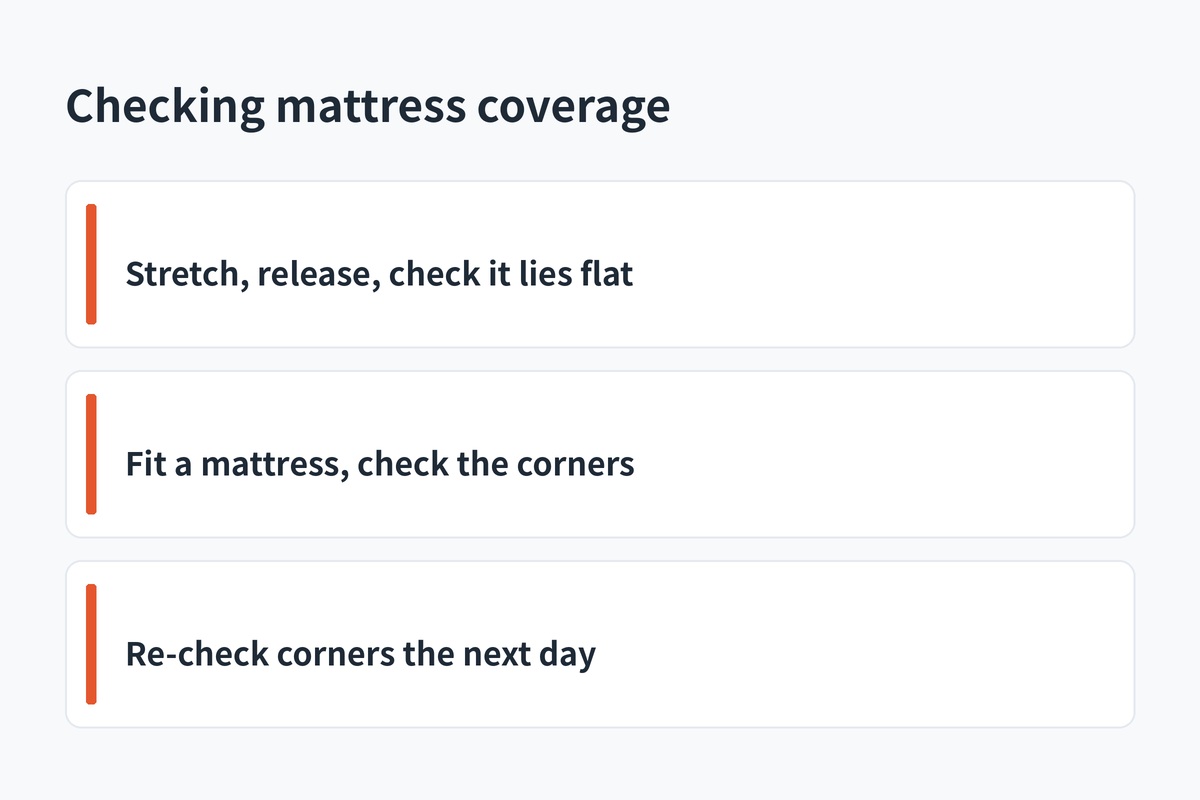
- Stretch and release: pull the swatch crosswise and lengthwise, release, and see whether it lies flat or keeps marks.
- Fit a mattress: put a sample sheet on a mattress of the target size; watch for bulging corners or slipping sides.
- Re-check the next day: leave it on and look at the corners again for sagging or creasing.
- Record conditions: note mattress size and depth; a different mattress needs a fresh check.
What should you check for overnight next-to-skin feel?
For fabric worn against skin all night, check hand feel and sleeping comfort first, then the safety category on the finished label. China Cotton Textile Association educational notes say nylon absorbs moisture relatively well among synthetics and feels a little more comfortable than polyester. Treat this as a qualitative guide and confirm by sleeping on a sample sheet.
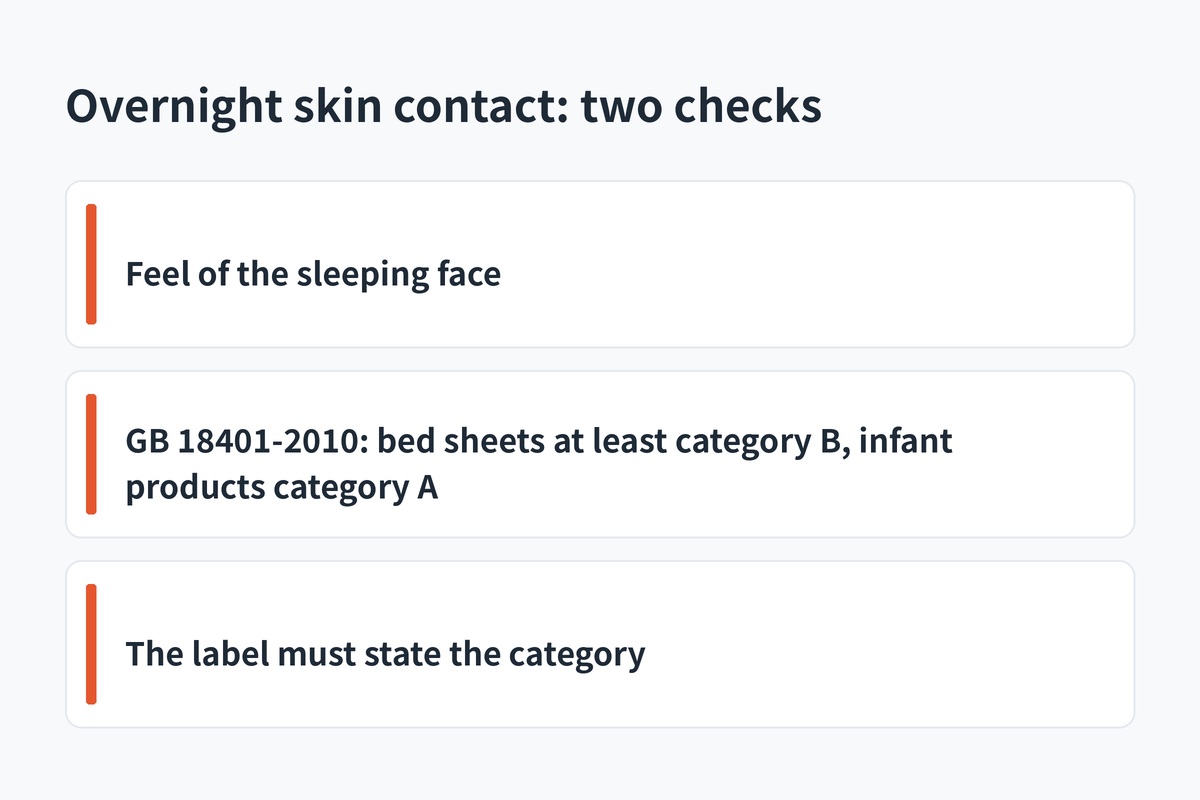
- Feel the sleeping face: identify the side that touches skin and rub it on the back of your hand and inner wrist for drag or itch.
- Safety category: GB 18401-2010 divides textiles into categories A, B and C; products in direct contact with skin, such as bed sheets, must meet at least category B, infant products must meet category A, and the label must state the category.
- Formaldehyde and pH: GB 18401-2010 sets category B at formaldehyde ≤75 mg/kg and pH 4.0-8.5, and category A at formaldehyde ≤20 mg/kg and pH 4.0-7.5.
- Documentation decides: the category a sheet can carry depends on test documentation for the finished product; no safety category is assigned to any Maoxing Textile Dyeing product here.
Fitted sheets are washed often: what do the pilling grade and the care label each check?
When sampling fitted-sheet fabric, the pilling grade checks pilling performance and the care label checks care requirements; each covers its own item. How the sheet looks after repeated washing needs a separate wash observation on samples and cannot be judged from these two directly.
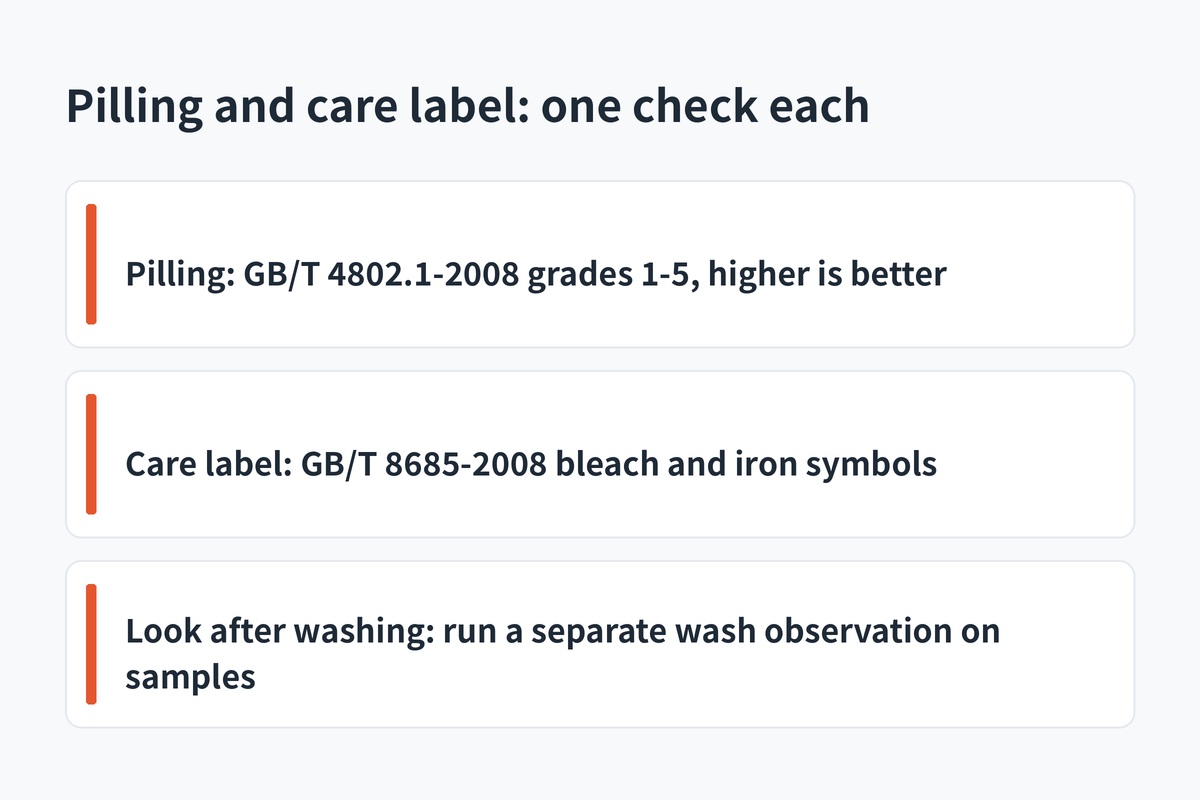
- Pilling grade: GB/T 4802.1-2008 (circular locus method) grades pilling 1 to 5: 5 no change, 4 slight, 3 moderate in some areas, 2 distinct over most of the area, 1 severe over the whole piece; higher is better. Check the report if one exists, otherwise record "not provided"; do not guess a grade by hand rubbing.
- Care label: in GB/T 8685-2008, bleaching symbols cover "any bleaching agent allowed", "only oxygen/non-chlorine bleach" and "do not bleach", and dots in the iron symbol mark the maximum soleplate temperature. Confirm the finished care label with the supplier before ordering.
Related: How to Care for Nylon Spandex Fabric: Ironing Heat, Sunlight and Chlorine
How do coverage, skin feel, washing and safety category compare?
Each of the four checks uses a different method; the table shows how to check, what to record and what not to infer.
| Check | How to sample | What to record | What not to infer |
|---|---|---|---|
| Mattress coverage | Stretch and release, fit a mattress, re-check next day | Bulging corners, slipping sides | A numerical recovery rate |
| Overnight skin feel | Feel the sleeping face, sleep on a sample | Drag, itch and other subjective notes | Safety category |
| Pilling performance | Check a GB/T 4802.1-2008 report | The pilling grade in the report | A grade for untested fabric |
| Care label | Compare with GB/T 8685-2008 symbols | Whether bleach and iron marks are clear | Actual heat tolerance of the fabric |
| Safety category | Check GB 18401-2010 documentation | Category on the finished label | That a soft hand means compliance |
What goes on a fitted-sheet sample log first?
Record these in order when sampling fitted-sheet fabric; if a document is missing, write "not provided". Maoxing Textile Dyeing has worked with nylon spandex fabric at Guangzhou Zhongda for 15 years, with our own knitting mill and our own dye house, and we suggest logging fitting results and documents in separate fields so one finding never stands in for another.
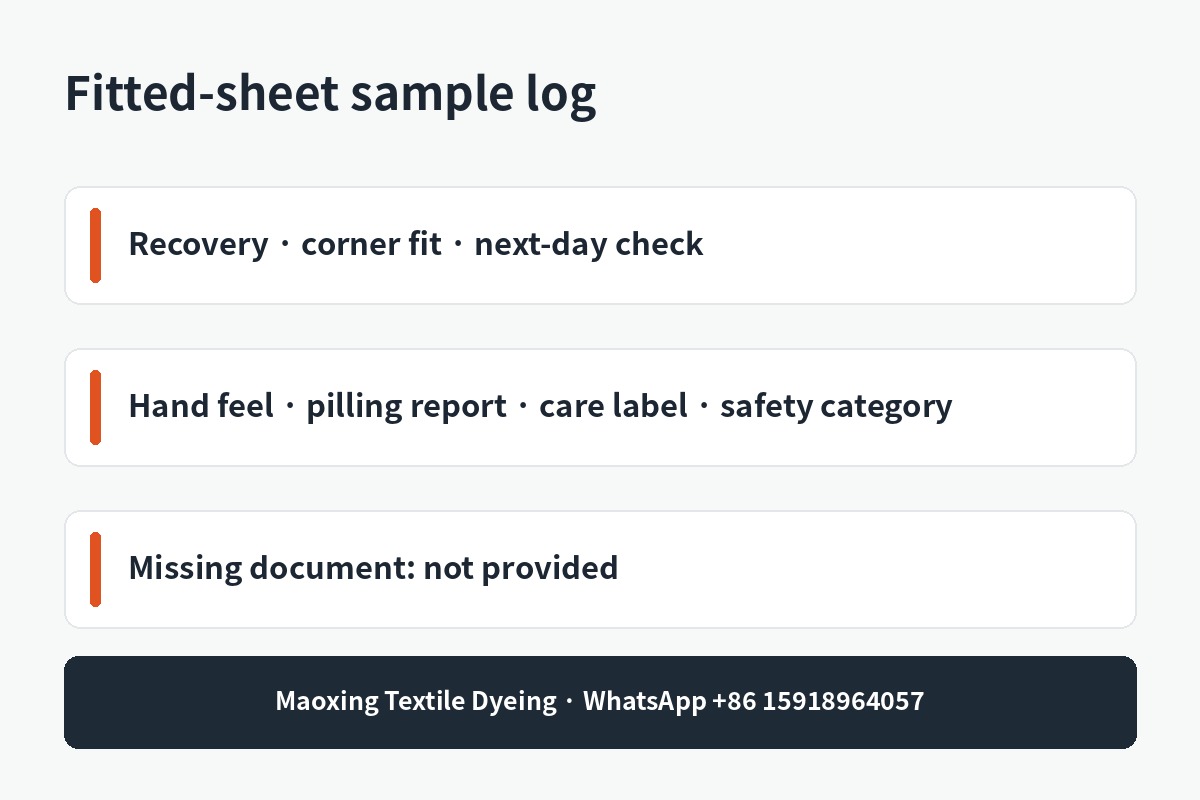
- [ ] Swatch composition stated; specs per the spec sheet
- [ ] Recovery after crosswise and lengthwise stretch
- [ ] Mattress size, depth and corner condition on test fit
- [ ] Corner sagging on next-day re-check
- [ ] Hand feel of the sleeping face
- [ ] Pilling grade from a report, or "not provided"
- [ ] Bleach and iron symbols on the finished care label
- [ ] Safety category on the finished label and its documentation
Related: Why Does Nylon Spandex Fabric Snag and Pill, and How to Avoid It?
FAQ
1. Which GB 18401-2010 category must a fitted sheet meet?
Products in direct contact with skin, such as bed sheets, must meet at least category B; infant products must meet category A, and the label must state the category. The category a sheet can carry depends on documentation for the finished product.
2. Will nylon spandex fitted-sheet corners loosen over time?
They can, so test-fit. Nylon has good elasticity and recovery but deforms under small forces; fit a mattress and re-check the corners the next day.
3. How do you read a fitted-sheet pilling grade?
GB/T 4802.1-2008 grades pilling 1 to 5, and a higher grade means better pilling resistance. If there is no report, record "not provided" rather than guessing by hand rubbing.
4. What details should I share when asking about nylon spandex fitted-sheet fabric?
Tell us the end use (fitted sheets), composition, GSM, width, color and quantity; swatch specs follow the spec sheet. WhatsApp: +86 15918964057.
Contact
Maoxing Textile Dyeing is a source knitting and dyeing factory specializing in nylon spandex stretch fabric, including fabric for fitted sheets. Showroom: Stall 16-18, North 5th Street, Zhongda Jiangnan Textile City, Haizhu District, Guangzhou. Contact us for details. WhatsApp: +86 15918964057. Email: zhangzengwen@mail.gzmaoxing.com