A darker, heavier fabric looks as if it should block more sun, but that is only an impression. Color and GSM (fabric weight) help you narrow down sun-protection fabric samples, but they cannot tell you how well a fabric blocks UV on their own. Whether a product counts as UV-protective depends on testing to GB/T 18830-2009 and on the label.
When sampling, change one variable at a time: compare GSM within one color, compare colors at one GSM, then check fabric density, and after that check reports and labels.
Related: How to Choose Sun Protection Fabric: Nylon Spandex UPF Clothing Guide
Do color and GSM tell you whether sun-protection fabric works?
No. Color and GSM are comparison points for sampling; UV protection is decided by test results. According to SAMR sun-protection buying guidance (republished by the Shanghai Medical Products Administration), under GB/T 18830-2009 Textiles - Evaluation for solar UV protective properties, a product can be called UV-protective only when UPF > 40 and long-wave UV (UVA) transmittance < 5%.
- Color: an appearance choice; this article gives no color-to-UPF conclusion, and color alone cannot tell you how protective a fabric is.
- GSM: a weight specification; this article gives no GSM-to-protection figures.
- What you can rely on: results tested to GB/T 18830-2009 and the garment label.
- Maoxing products: no UPF value is assigned to any Maoxing fabric here; protection depends on the relevant test report.
How should you set color and GSM ranges before sampling?
Before sampling sun-protection fabric, set a group of candidate colors and a group of candidate GSMs for the style, then compare in groups instead of changing several conditions at once. Change color, GSM and knit together, and even if you see a difference, you cannot tell which one caused it.
- Define the use: long-sleeve jacket, cardigan or close-fitting top; the use sets the GSM range to try.
- Set the color group: list the colors for the collection; sample each color separately.
- Set the GSM group: pick two or three weights in the same composition and knit; confirm actual GSM from the supplier's spec sheet. No recommended figures are given here.
- Label every swatch: color name, GSM, composition and knit, kept with the swatch for comparison and ordering.
What do you check when comparing GSM within a color, and colors at one GSM?
Comparing GSM within one color shows differences in hand, drape and see-through; comparing colors at one GSM shows whether the color can be reproduced. Keep the two comparisons separate so each finding maps to one condition.
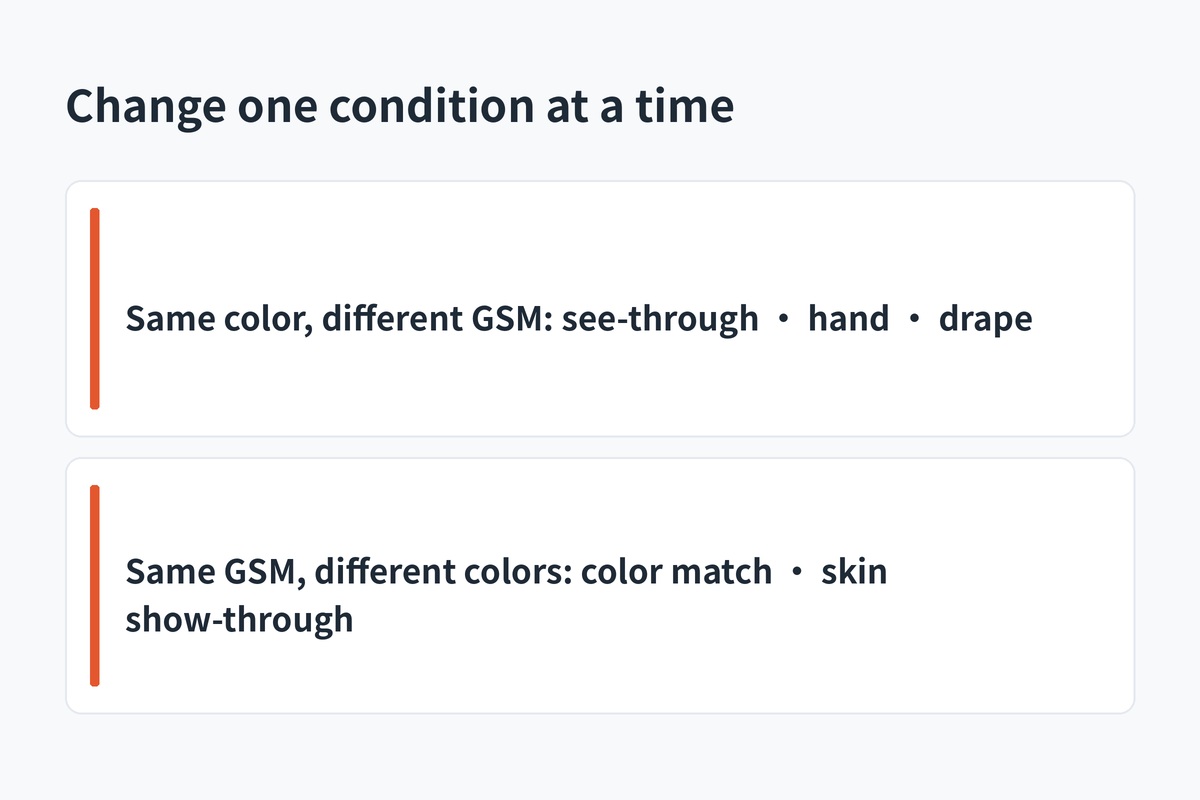
- Same color, different GSM: lay swatches side by side under one light, check see-through, hand and drape. Record observations only; "looks opaque" is not a protection claim.
- Same GSM, different colors: check each color against the design; for light colors, check whether skin tone shows through.
- Check again stretched: nylon has good elasticity and recovery but deforms easily under small forces (China Cotton Textile Association educational notes). Elbows and shoulders stretch in wear, so re-check swatches against light while stretched.
- One change per comparison: only then can you say whether color or GSM made the difference.
Why check fabric density separately?
Check density separately because sun-protection fabrics of the same GSM can differ in density, and density relates to UV protection. The same SAMR guidance says higher fabric density gives relatively better UV protection.
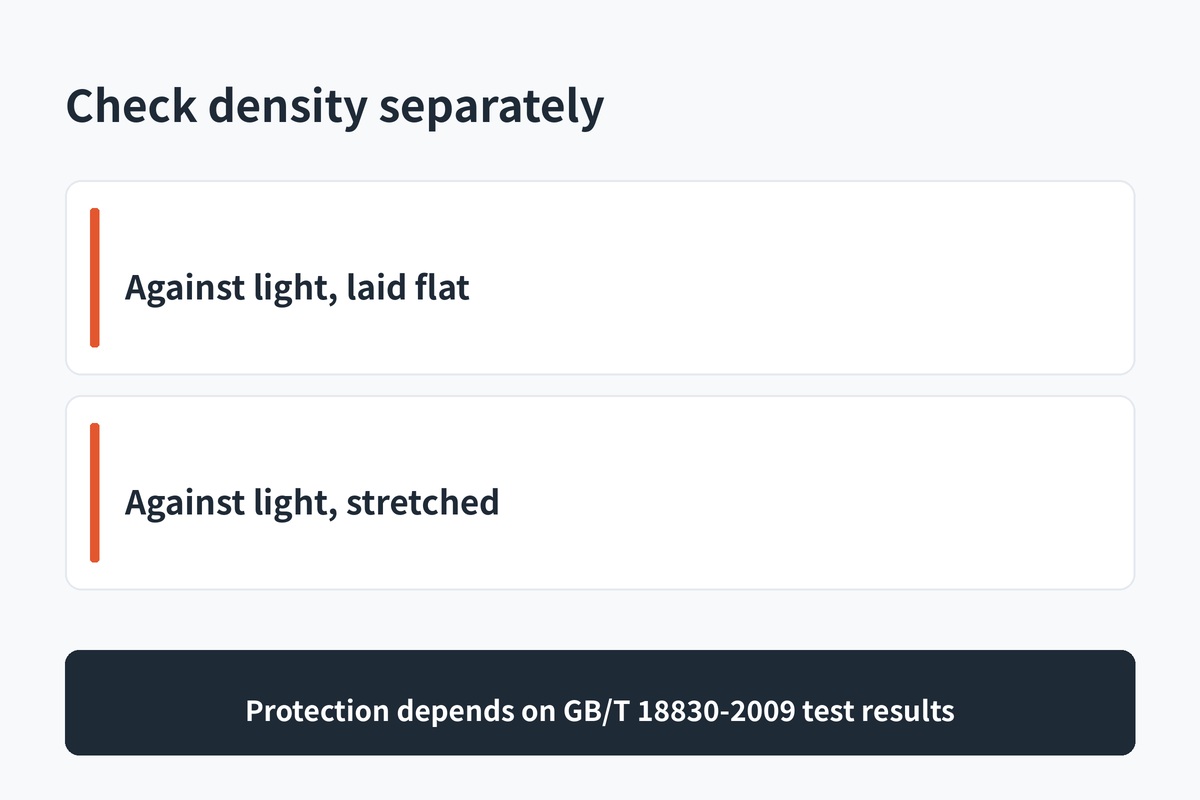
- Look at gaps against light: are openings even or obvious?
- Flat and stretched: gaps usually open up when stretched; record how much.
- Ask for specs: ask the supplier for knit and density-related specifications; the spec sheet decides.
- Not a substitute for testing: density only helps screen samples; protection is judged by GB/T 18830-2009 results.
What else matters when choosing color and GSM in nylon spandex?
Nylon spandex sun-protection fabric benefits from nylon's high strength and good abrasion resistance, but you need to watch for deformation and creasing under small forces. All points here are qualitative, from China Cotton Textile Association educational notes.
- Lighter weights and durability: nylon is strong and abrasion-resistant, so lighter GSM candidates are worth comparing; wear-test cuffs and shoulders.
- Comfort next to skin: nylon absorbs moisture relatively well for a synthetic and feels a little more comfortable than polyester.
- Creasing: crush a swatch and release; creases show more on light colors.
Maoxing Textile Dyeing has worked with nylon spandex fabric at Guangzhou Zhongda for 15 years, with our own knitting mill and our own dye house. When buyers sample sun-protection fabric with us, we suggest logging color, GSM and observations for every swatch on one sheet, and using that sheet for comparison and ordering.
Color, GSM and density: comparison table
Color, GSM and density each answer different questions; the table shows how to compare each, what to record, and what not to infer.
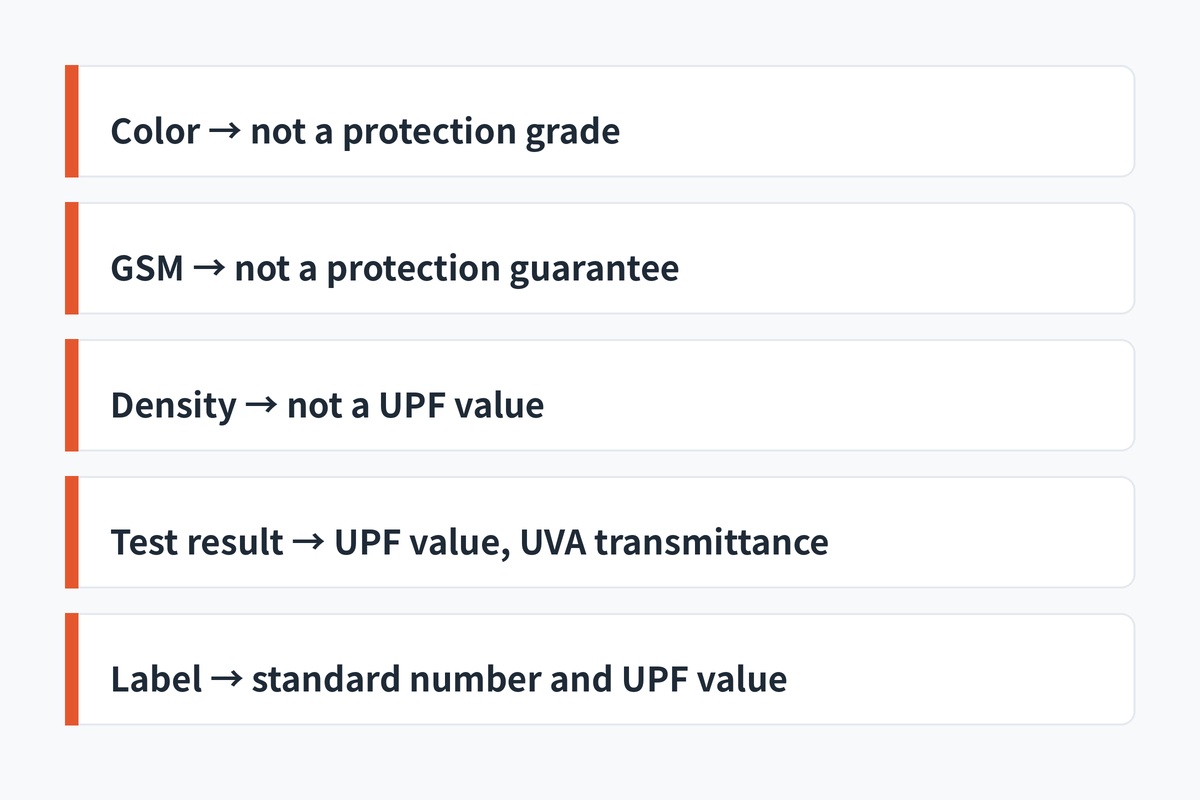
| Check | How to compare | What to record | What not to infer |
|---|---|---|---|
| Color | Different colors at the same GSM | Matches design; skin show-through on light colors | That one color has a higher protection grade |
| GSM | Different weights in the same color | Hand, drape, see-through | That a given GSM guarantees protection |
| Density | Against light, flat and stretched | Gap size and evenness | A UPF value |
| Test result | Results to GB/T 18830-2009 | UPF value, UVA transmittance | Protection of untested swatches |
| Label | Standard number and UPF value | Whether labeling is complete | Protection for items without a UPF label |
Sample log: what should you check first on sun-protection fabric?
Tick these in order when sampling; if a document is missing, write "not provided".
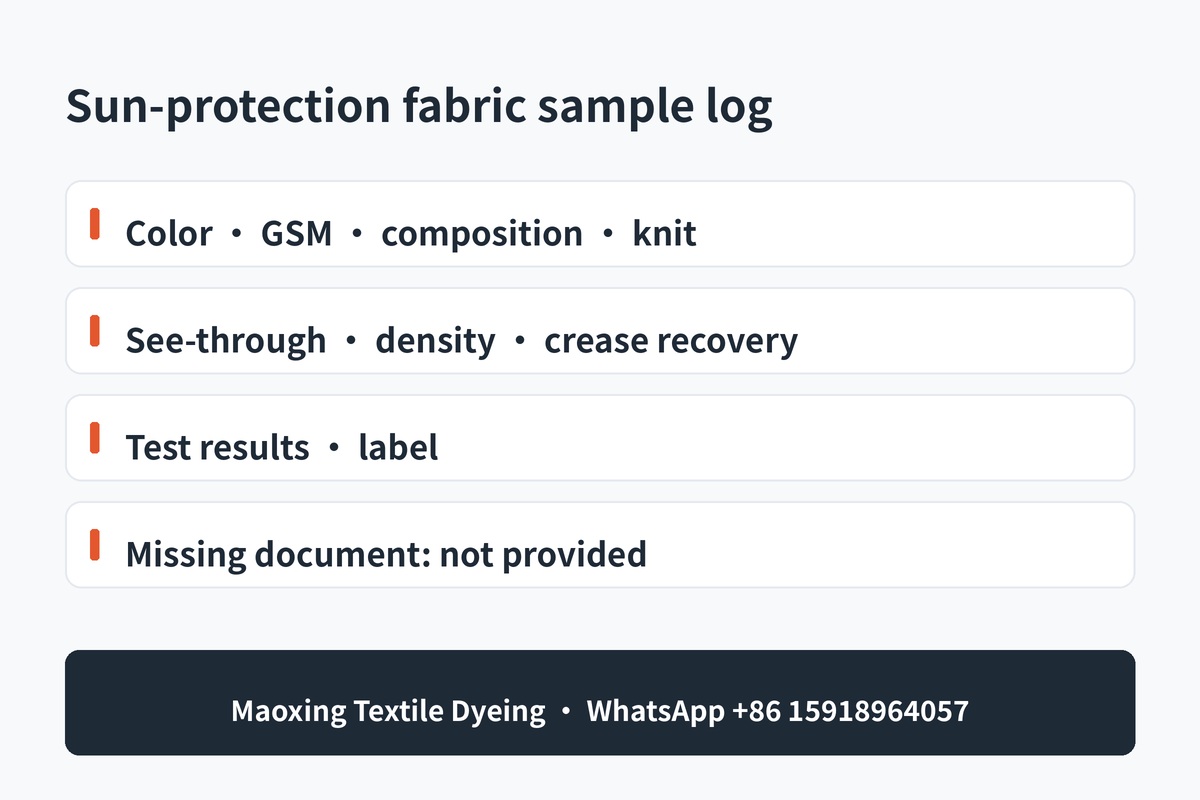
- [ ] Each swatch labeled with color name, GSM, composition and knit
- [ ] Same color, different GSM: see-through, hand and drape recorded
- [ ] Same GSM, different colors: color match and skin show-through recorded
- [ ] Density: gaps checked flat and stretched against light
- [ ] Crease recovery after crushing recorded
- [ ] Test results to GB/T 18830-2009 available, or "not provided"
- [ ] Label: provided UVA transmittance is < 5%, 40 < UPF ≤ 50 is labeled "UPF40+", UPF > 50 is labeled "UPF50+"; check for the standard number and UPF value
Related: How to Choose Fishing Shirt Fabric: Sun Protection, Abrasion and Lightfastness
FAQ
Is heavier sun-protection fabric always more protective?
You cannot judge it that way. GSM is weight; UV protection depends on GB/T 18830-2009 results, and fabrics of the same GSM can differ in density.
Can light colors be used for sun-protection garments?
Yes, but sample and test them separately. Check skin show-through when sampling, and judge protection by test results and the label.
What is the difference between UPF40+ and UPF50+ on a label?
They cover different UPF ranges. Provided UVA transmittance is < 5%, 40 < UPF ≤ 50 is labeled "UPF40+", UPF > 50 is "UPF50+"; also check that the label carries the standard number.
If the same fabric comes in a new color, does it need new testing?
Confirm by color. This article gives no color-to-UPF conclusion, and color alone is not a basis for judging protection; after a color change, check the test results for that specific color with the supplier.
Contact
Maoxing Textile Dyeing is a source knitting and dyeing factory specializing in nylon spandex stretch fabric, including fabric for sun-protection clothing. Showroom: Stall 16-18, North 5th Street, Zhongda Jiangnan Textile City, Haizhu District, Guangzhou. WhatsApp: +86 15918964057. Email: zhangzengwen@mail.gzmaoxing.com